Unknown's avatar

About Leo Winkley

Headmaster of Shrewsbury School

Dear Pedestrian

Featured

Solvitur ambulando: ‘It is solved by walking.’

As a walker, you know this well.

This pithy saying – all the more pithy in Latin – is attributed to St Augustine.  It captures the sense that walking is more than just a physical activity.  Rather, it suggests that walking can be an act of mindfulness; a means of spiritual refreshment; a way of untangling the knots of the mind.  For many, walking and thinking are the closest of travelling companions.

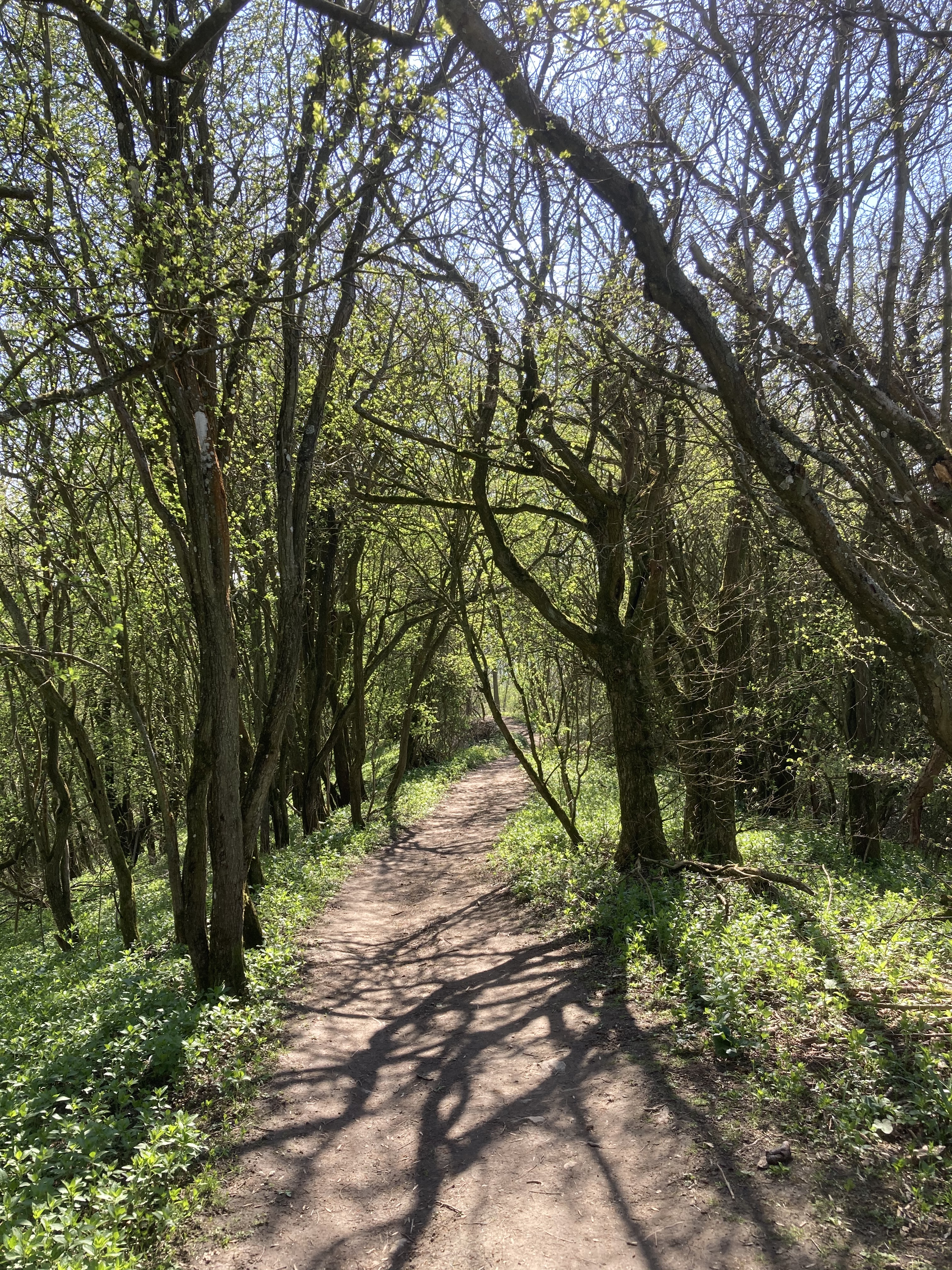
I went through a phase of reading book after book about walking. It was in the aftermath of my father’s death in 2014.  I think, looking back, it was a way of reflecting on his life and its ending.  Big, long walks in the Yorkshire countryside were a way of processing.  I felt drawn to the paths of the East Yorkshire coast; it felt good to be small, yet strangely at home, in the rugged openness of the Moors; the gentle dales and valleys invited me to explore.  Following ancient ways – paths that had been covered by countless pairs of feet – connected me to the unknown folk who have lived and moved across the same land.   

When I wasn’t walking, I was thinking about walking.  I was reading about walking.  I read books by Robert Macfarlane, Roger Deakin, Henry David Thoreau, Frederic Gros, Rebecca Solnit, Geoff Nicholson, Nan Shephard, Patrick Leigh Fermor.  There are shelves of books on walking, natural history, landscape and language, psychogeography – all kept in our little cottage in the North York Moors.

Holloway

My inner teenager would be both baffled and appalled at this strange obsession with the act of walking.  How on earth can walking be interesting?  The Pavlovian response of most teenagers at the prospect of a long country walk is a derisory scoff or a spontaneous list of other more urgent priorities.  For some, walking looks like a waste of time and energy.  Especially the circular walk beloved of ramblers – why on earth would we walk in a big circle that ends up where we started? 

The word pedestrian (as an adjective) has a telling meaning: ‘prosaic, commonplace, dull’. Doesn’t that tell us something about the status of a walk?

Most prosaically, of course, walking is an act of locomotion; of self-propulsion; it is the simplest practice of getting from A to B.  It is a form of exercise and means of staying physically healthy.  More expansively, walking is a way to discover and explore the external world.  At a deeper level, walking can make us happier.     

Like many of the routine capacities that the fit and healthy take for granted, the able-bodied take the daily process of walking unthinkingly in our stride.  For those who find walking easy, we don’t often register that this unconscious process is supremely complex.  The ability to walk was hard-earned, and hard-learned, over months of early childhood development.  We learn to walk and are free.  Viewed this way, walking is a privilege.  More empoweringly conceived, it is an act of self-determination.  And a route to inner discovery.

You can see why slow self-locomotion seems ordinary next to the rapid movement of car, plane and rocket.  As the industrial revolution brought speed, along with so much else, shanks’ pony became equated with backwardness and poverty.

And yet… slow can be good.

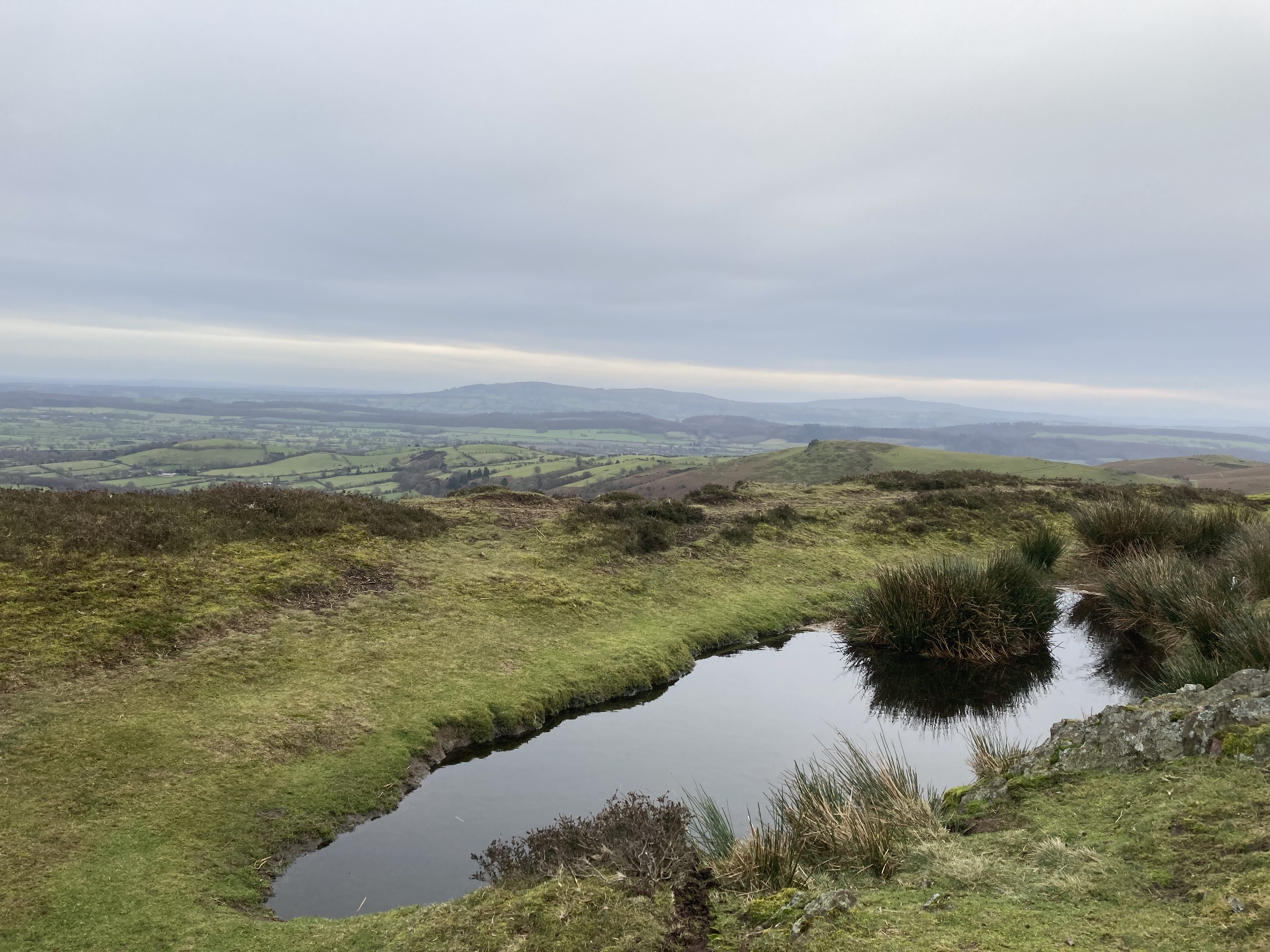
View from Caer Caradoc

During lockdown, the daily walk has become disproportionately important.  For most, the local wander was the default leisure activity.  Ask someone what they did at the weekend during lockdown and they will almost certainly reference a walk.  Being pedestrian has been crucial to our wellbeing.

In the 18th and 19th centuries, pedestrianism was a spectator sport; an heroic activity that drew fans and inspired a degree of celebrity.  Walking was a means to epic feats and the focus of wild wagers.  For example, the legendary pedestrian Captain Robert Barclay Allardice’s most impressive achievement was to walk 1 mile every hour for 1000 consecutive hours between 1st and 12th July 1809.  People travelled to see him walk.  Many other men and women became competitive endurance or speed walkers.  Over time, this craze for pedestrianism gradually passed and became obsolete.  However, history shows that being a pedestrian was not always pedestrian.  

Returning to the current day, walking is a means of exercise and relaxation for many.  You come back from a decent walk feeling physically tired and mentally refreshed.  The quick wander with the dog; the late afternoon perambulation – these all help to dislodge the lumps in the mind’s path. 

I think it is one of the many uniquely special things about Shrewsbury School life that we – by which I mean pupils and staff alike – all do a lot of walking in our daily routines.  Our 100 acre site has walking designed into it. 

Shrewsbury School Site – walking to work

We have to walk from house to lessons; from one building to another; to and from meals.  We walk through a shared  place of calm, natural beauty. I think this is a very healthy thing for all of us.

Walking, woven into our daily routines, is good for the mind and the body.  And it can also help with problem-solving.

Whatever ‘it’ is – it may well be solved, or at least eased, by walking.

Keep walking, dear Pedestrian. 

Dear Three-Dimensional Learner

Featured

As schools in England re-opened for the final weeks of the Easter term, we returned to three-dimensional learning.  After seven weeks of screen time – delivered and shared with as much creativity and energy as we could collectively command – it was a joyful relief to be back in person. 

Three-dimensional learning is, without doubt, the best way to go.  This is particularly the case in boarding schools.  

Certainly, we have shown that a boarding school in remote is possible.  Indeed, necessity has been the mother of some extraordinary invention. We have shown that whole person education can be re-invented for the screen and much can be achieved through flipped learning; break-out rooms; online challenges; virtual collaboration.  Those still not able to be with us here in Shrewsbury have continued to access Online Supported Learning; to take part in house life; to engage in a virtual co-curriculum.  It is vital that we find the best ways to stay together when we are apart.

However, what has been evidenced strongly in our most recent return to in-person learning is that the deepest kinds of learning happen best when we a real community.  That is not to say that great learning cannot happen virtually: it can. But, personal development is a multi-aspect process. Some things can be done by remote control; some things are best down hands-on – albeit at a social distance. 

What we know, though, is that a Shrewsbury Education has one-off elements that achieve full colour and depth when it happens in three dimensions.  Our culture, our educational philosophy, our unique brand of ‘whole person education’ – these are rooted in a sense of belonging to a distinctive community in a real place.

Some of the craft of teaching and learning can be transferred to the screen: we have seen this.  Teachers and learners have undergone a paradigm shift of capability over the past year.  We have seen significant gains in two-dimensional mode.  But a virtual boarding school is, fundamentally, a contradiction in terms. 

We knew it before, and we know it even more deeply now: a boarding school community is three-dimensional.  As we pass the one-year milestone of lockdowns in England, it is clearer than ever that learning in person gives the broadest range of opportunity.  In person, we are constantly connecting, sharing, challenging, transforming, enjoying, celebrating within a real community of real individuals.

It has been profoundly affirming to have you – the three-dimensional learner – back in person.  Back, we hope, for good.    

Dear Optimist

Featured

How are you?  Great, no doubt.  You always say that.

But seriously, it’s been a tough time for you lately, hasn’t it?  I know your policy is always to see life’s glass half-full.  You’re so good at keeping your chin up; turning those lemons into lemonade. You always focus on the other fish in the sea; you never dwell long on the one that got away.  Nothing will shake your belief that the closing of one door leads cheeringly to the opening of another.  You travel with the unshakeable belief that, however difficult the journey, its delays and deviations will all make sense backwards.  You float through your days with lightness of spirit, however many sandbags are tethered to your balloon.  You’re always a cork; never a stone.

You’ll rightly point out that optimism is good for us.  There’s a stack of evidence to support this.  Optimism has many a vocal sponsor, present and past.  You’ll point doubters to numerous nuggets of upbeat wisdom.  Such as this, from one of those great optimists who triumphed, always with humility, over the obstacles she faced:

“Optimism is the faith that leads to achievement…no pessimist ever discovered the secret of the stars, or sailed to an uncharted land, or opened a new doorway for the human spirit’.

Helen Keller, author and activist (1880 – 1968)

You and your kind walk together on hope’s mossy ground. Air-cushioned shoes soften your steps.  But…

Even you must have felt the earth tremble and shake beneath your springy feet.  Even you must be struggling to see the upside these days.  Even the most clear-eyed spotter of the silver-lining has had her work cut out of late.  As 2020 turned into 2021, the champagne corks popped in muted domestic isolation.  Fresh hopes gathered, but the new year has brought more difficulty.  The light is at the end of the tunnel, you’ll say.  I believe you.  But even you must admit that the tunnel keeps getting longer.   

Don’t get me wrong.  I’m right with you.  Optimism is the way forward. 

In fact, I learn that there are lots of types of optimism, so I should be more precise.  Most optimism is good for you.  Yet, as with most things in life, used to excess, it can turn bad. 

I don’t want to spoil the mood.  But I need to ask.  Can you see any downsides to our optimism?  Well, naturally, you’ll be too interested in the upsides to pay that notion too much attention.  But, it seems, we optimists need to keep it real.  If you insist (as I do) on being so upbeat all the time, we do need to make sure you stand close to the pessimists from time to time and let them speak.  We optimists need to listen to them carefully. 

Optimism bias can do real harm to your strategic planning.  You always tend to interpret the numbers, the data, into the best-case scenario.  Make sure you have some doomsters around you to paint it black.  That way, you’ll have a more rounded plan. 

In an uncertain or rapidly changing business situation, the optimist’s relative disregard for detail, selective inattention to unpromising data and failure to seek new information combine to produce poorly-informed decisions.  So, we optimists need to keep our eyes open to the detail.  And make sure that we share it with others who will likely interpret things differently.  They may spot that the half-full glass has a crack in it.

Optimism bias is a main cause of the chronic inability accurately to anticipate the costs of big projects.  This has been a major issue for governments and private companies for decades.  The grand, compelling vision was so mesmerising that the numbers lost their power to communicate.

Do you mind my asking, how are your personal finances?  Well, yes, it’s not a very polite enquiry but research has shown that similar factors affect personal finance decisions.  Why do so many people consistently pick credit card options that really don’t help them?  Investigations found that people often choose credit cards with a low annual fee and high APR, despite the fact that they regularly fail to clear their balances and pay much more than if they had a higher fee, lower APR card. These are the optimists.  Or are they the putters-off?  The evaders of reality?  The high fee is an immediate but solvable problem (opt for the smaller fee) and the more distant possible failure to pay off the balance thus accruing interest, is an event they believe will somehow not really happen.

It’s just an example.  As is that fact that the high general optimism of children, especially boys, seems to be a contributory factor to accidental injury in childhood.  Sorry to strike a gloomy note again, but it seems that the risk-taker will often be the optimist; and that optimists get hurt more often.  They find it harder to believe that bad things could happen.  This general disposition is surely a strength, isn’t it?   Perhaps a virtue?  

Aristotle’s theory of the Golden Mean suggests, we should avoid extremes.  Global optimism is not clever.  Too much exposure to the bright side will damage your sight permanently.  Courage, un-tempered, is recklessness.  Optimism needs to be tempered by realism; annealed in the furnace of fact.  Optimism, un-tempered, will take some into cloud cuckoo land, a state of optimistic fantasy.  This may be a lovely state of being for a moment, but life’s problems cannot be solved or endured by escape or delusion.  Optimism is a rosy filter but it cannot change the image itself.  The way we view life will help us to address issues that must – in reality – be met firmly on their own hard ground.

Which leads us back to the moment. These current times have put a dent in the soul of every optimist, surely. Even the corkiest of us must be feeling the gravitational pull of the deep. With good reason: we are living in dark, difficult days. And yet…   

Where does this leave us in our optimism?  As the Swedish proverb goes: “Those who wish to sing will always find a song”.  Yes, we must keep singing our songs. 

We must keep counting our blessings. 

And remember to ask a friendly pessimist to check our arithmetic from time to time.

Dear Donald

Featured

You prefer a DM, but here’s a letter. Maybe I’ll send it to your Washington, DC address.  And hope it catches you before the removal crew arrives.

Yes, you’re leaving: moving out of the White House.  The American people who put you there in 2016 have now served notice.  Of course, you’re challenging the landlord.  But you must know it’s time to leave, if not leave quietly. 

The people who put you there knew that you were going to be unconventional.  They knew that you were going to blast your way through all the normal codes.  They wanted you to do just that. They wanted you to speak unfiltered; to appeal to the gut; to give voice to the millions who felt voiceless.   To those whom you championed, you could do no wrong. 

They did not elect a statesman; someone who would unite in victory.  They chose a divider.  A slash-and-burner.  Someone who would become more and more convinced of his invincibility, insulated by a boo-hooray bubble of loyal support; enabled by a street-smart entourage and a legal team on steroids. 

You have given the world something truly special: self-authenticating, fact-free correctness.

In the end, when it came to bidding for a second term, too many people were put off by your aggressiveness.  Your stoking of tensions.  Your deliberate expansion of the differences between those whom you rated and those you slammed.  The badmouthing of traditional allies finally tired.  Your rapt admiration for the world’s authoritarian strongmen.  You acted as if the handbook for global statesmanship was the plotline of ‘Despicable Me’.

History will show that your tenure was a wild, fantastic aberration, won’t it?  Right from the jaw-dropping moment four years ago when the impossible happened, it’s been a four-year episode of The Simpsons.  Fiction made fact; fake news made real. Right?

Photo by Joshua Miranda on Pexels.com

But I am wrong. 

As wrong now as I was then – in 2016 – when I went to bed knowing that it would be Hillary. 

You were never impossible.  You were inevitable. 

I lacked the insight to see your power.  Insulated by my middle-class, old-world attitudes; cosy in my comfortable liberalism; doped by my total lack of understanding of the United States; blind to the frustrations that now erupt from the volcanic inequality of our times.

The wise saw you coming a mile off.  They knew your power before it was real.  The Real Donald Trump.  Destined to be number 45.  You captured millions of votes.  You were properly elected through a properly democratic process.  Free of any skulduggery or intervention from other powers – so far as I know, anyway.  It was a fair win in 2016 – narrow, but fair. 

People saw something in you.  You timed a wave; your words chimed with people who felt marginalised; untouched and under-represented  by politics; unheard; airbrushed out.  You were real to them.  You promised some kind of inversion, turning the old certainties on their heads.     

I am absolutely no expert.  And you won’t read this, it goes without saying.  It seems to me that the version of politics that you invented was all about you.  Like everything else: the foreign policy. The pistol-fired tweets. The weakness for guns. The furious golf. The manic orange glow of self-belief. The anti-COVID bleach you urged into your people’s veins.

It was all you.  Your peculiar populist genius.  The Donald. 

Now, as 2020 enters its final weeks, you are ending as you arrived.  Calling foul with a puckered pout and blow-torching any still-standing norm of decency that has miraculously evaded your fire so far.

It’s been box office, for sure.  Fascinating to see the dignity of office debased.  Iconoclasm is compelling viewing, it seems.  The world has got used to the bombastic, capitalised salvos; the apparent lack of regard for logic, evidence, fact. These are displaced by the fire of emotion, conviction and sheer bloody will. 

Never mind the politics. What kind of example have you set? Really? What have you done for leadership, dignity, democracy?

I can only hope that your actions have equal and opposite reactions in the years ahead. A change of tone to a gentler, kinder, more factful leadership. It will take a long time to heal the divides and rebuild the trust. I hope the next guy in finds a way to reframe the way democracy talks to itself. It’s time to seek proper greatness. 

LW

A Letter From Shrewsbury. Serious Fun. My views only.

Back to your tower.
Photo by Priya Karkare on Pexels.com

Dear Ben Gone to the Sea

Featured

A Letter From Shrewsbury on the poetry of Ben North, who died 18th October 2020, aged 49.

We never met. And now you are gone.

Twitter introduced us. Your final Tweets: some algorithm brought them to me. It told me that you were dying of a brain tumour. Two in fact.

In this strange, garbled age of unfiltered sharing, your words cut through.

Image
Ben North, poet.

You left behind a trail. It’s clear that you were very well loved. Successful. Creative. And I see that you were noble and angry; brave and gentle in your suffering.

The algorithm led me to discover your book of poetry: ‘Thirty-Three Poems: some of which are about death‘. Dying shared. Poetry shared.

They are beautiful. This one, for example, about a clear, crisp night:

Ben North

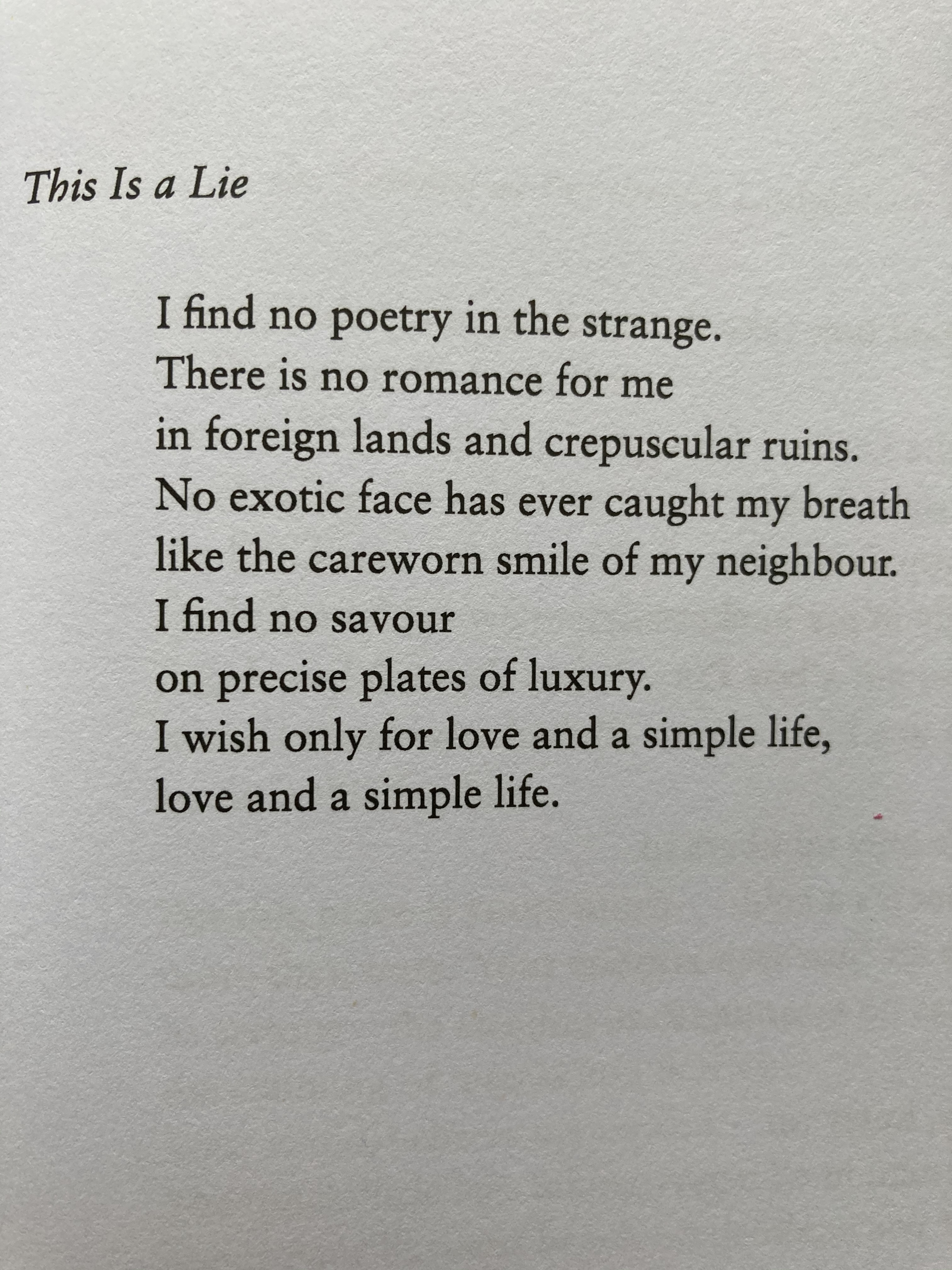
Or this one, clever and wise – ‘This Is a Lie‘:

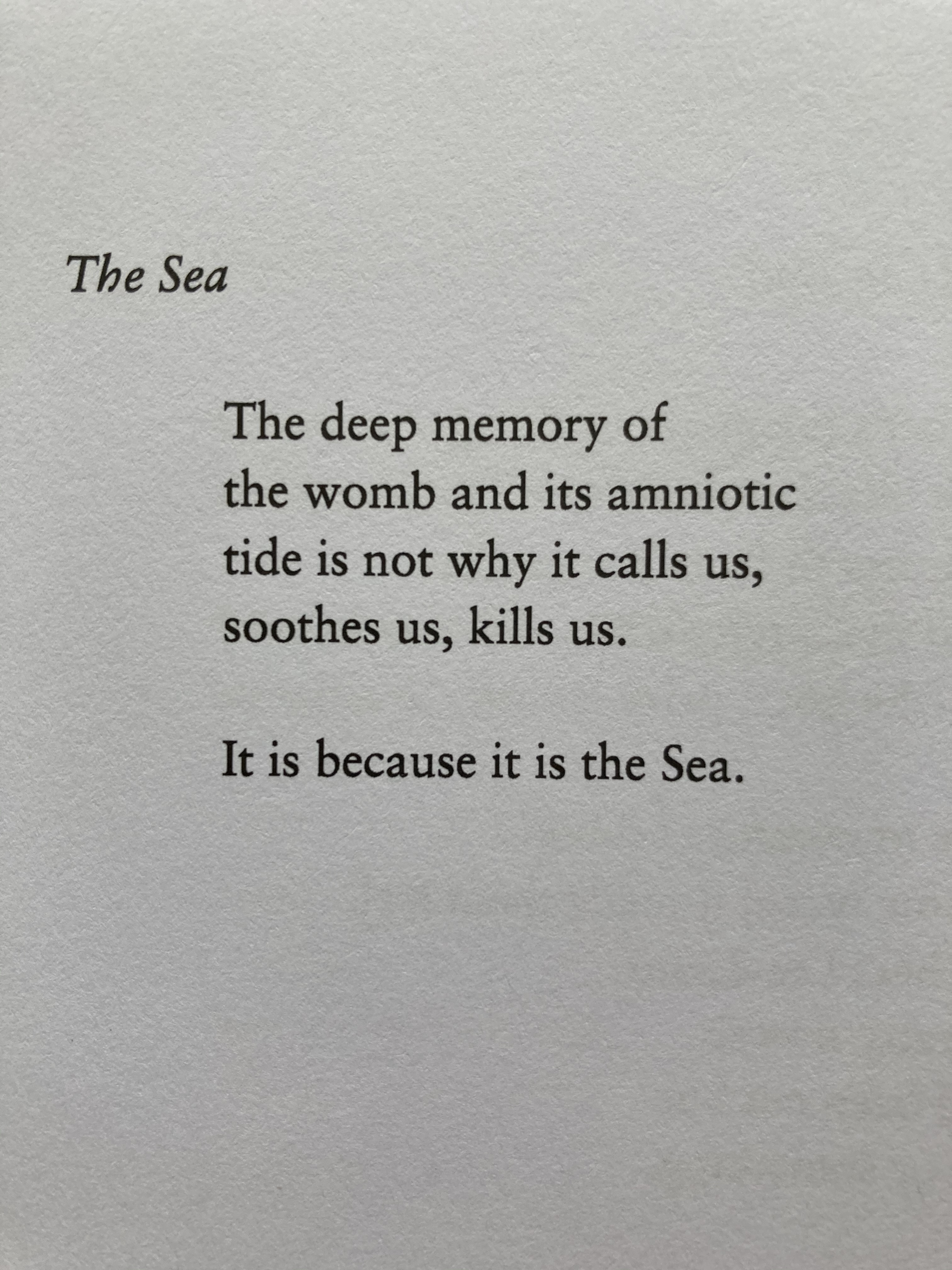
The final poem in your collection is called ‘The Sea‘. As I write this short letter, I am looking at the slate-grey waters of the North Sea. It is five days on from the day you died. I read it again and consider its simplicity, which is its power. It was not, I think, your last poem. But it is an ending:

‘The Sea’ by Ben North

Your poems are not brilliant because you were dying. They are brilliant because they are brilliant.

It’s hard not to wonder what else you might have written. As it is, you are gone; and you leave us 33 poems. A slim volume, you said. Yes, short. But full of wisdom and humanity.

What is the end of a poet? To leave something that endures? To connect? To look at the Sea and put it to words. Before the end of the poet.

Thank you, Ben. We never met – but I feel that I would have liked you very much.

Ben’s volume of poetry is priced £2.99 and available from Amazon.

Dear Minister for Exams

Featured

There is something in the air. In fact, everything seems to be up in the air just at the moment.  I’m not only talking about the logistics of the Summer 2021 exam session – though some good sense and clarity on that would be good. I really hope that you listen to the experts: those who teach and support children.

It’s the whole thing, really. It feels as though it’s time you took a long hard look at yourself.

You’re probably way too busy to read letters. I’ll bet you get a lot. Such as this one; or the one I sent to the paper the other day, suggesting that we have a golden opportunity to re-think how pupils’ learning and wider skills are assessed. 

Daily Telegraph, 7th October 2020

This is a big picture discussion that would need to be held across the width and breadth of education.  When GCSEs were invented, the school leaving age was 16.  Children in England are assessed by written test more than most others on the planet.  As we all know, written tests are not the only measure of a person. Time for a re-think, surely?

Rethinking assessment – a cross-sector alliance

I should perhaps emphasise that Shrewsbury pupils do very well indeed on the current diet.  Our GCSE results are excellent. We prepare our pupils well and they succeed in these examinations. In that narrow sense, nothing’s broken from our point of view.  These assessments are a significant part of the story but our teaching extends beyond the set curriculum; we aim to explore and instil a true love of learning.  Character strengths, skills and aptitudes are developed outside the classroom: through sport, music, drama, expressive arts, leadership, enterprise and adventure, to name a few. 

Learning cross-fertilises and our pupils are recognised and developed not just in the exam hall but across a wide field of activity.  This is what we call ‘whole person education’: the intellective development, which is in part measured by examinations, is allied to active, expressive and reflective learning.  The process is about becoming fully human and developing Salopian virtues that will last a lifetime.

Shrewsbury has a long history of asking difficult questions and being willing to challenge the status quo.  Is our examination system fair?  Can we influence it to be fairer, more holistic, more responsive to the teachers’ knowledge of the children– more fully human. How can we exercise our independence to provide a broad and holistic curriculum?  Recent history shows that we are seizing opportunities here: the introduction of the Institute of Leadership and Management Young Leaders Award and the creation of Shrewsbury U, for example.

I know we’re all struggling day to day. Big thinking takes time and effort – and genuine will to address issues. At a national, system level, there is a debate to be had. This feels like the time.

I have two questions for you, the fictional Minister for Exams:

Question 1: Is there a better, fairer, more human way to assess our children?

Question 2: Read Brian Patten’s great poem, The Minister for Exams? And discuss.

Brian Patten
Brian Patten
‘How shallow is the soul of the Minister for Exams?’

Is there are better, fairer, more human way to assess our children?

Dear John on the Mainland

a brief meditation on connecting to the main

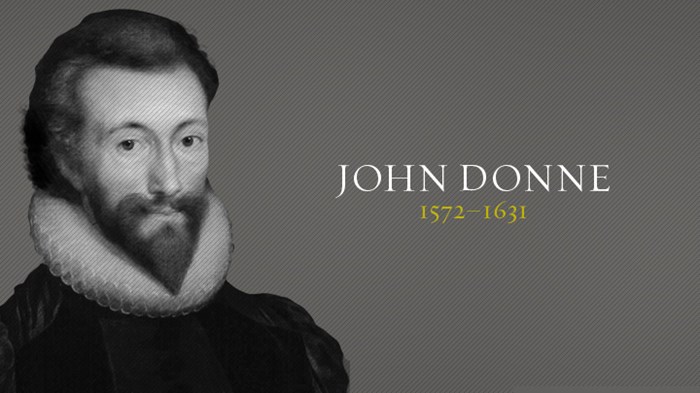
Your oft-quoted lines suggest that “No man is an island entire of itself; every man is a piece of the continent, a part of the main” [John Donne, Meditation 17]. You were talking of the ultimate separation that our mortality entails.

In a time when we are trying to operate a community that is both together but distanced, your words take on new meaning.

The sense of isolation that characterised many young people’s experience of lockdown has, with the re-opening of schools in September, been replaced by a renewed sense of community. We learn each day not just how important community is; but also how challenging the time in lockdown was for so many. Concerns over how much learning was actually achieved across the UK’s schools during the remote period are matched by a watchfulness over the mental health impacts of the past six months on the nation’s children.

Shrewsbury has found a way to thrive under the necessary limitations of the day.  These first five weeks of term, we have all been on campus pretty much non-stop seven days a week.  This has generated a strong sense of togetherness and community.  Equally, we remain alert to the world beyond and our part in it.  Our school is strongly embedded in its local community and we strive to play a positive role in society. 

We were quietly proud to share the news that we have been listed as finalists in the national Independent Schools of the Year Award 2020 for community outreach (winners to be announced 8 October 2020). [Update: we won two awards!] During lockdown, our community engagement work continued, with the Design and Technology Faculty making hundreds of protective visors; the school donated PPE and webcams to local hospitals and surgeries. Difficult times call for sharing, rather than looking after our own interests: sharing, not hoarding.

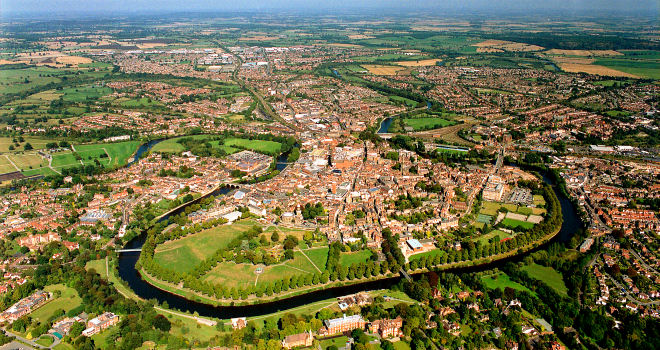
Shrewsbury the town is, of course, a nearly-island. Nestled in a graceful loop of the River Severn.

Shrewsbury. Not quite an island.

Yet, we are connected to the mainland. Alongside an historic association with the Shewsy, our youth club in Everton, and numerous volunteering programmes and educational partnerships with over 30 state schools, this community activity is part of our essence.  And it is essential that our pupils foster and develop a keen sense of social responsibility during their time at the school.    

We will continue to work hard to give the pupils the best experience that they can have. And to extend opportunities in collaboration with partner schools in the state sector.  We are proud to be a distinctive community – a Salopian nearly-island – but we are also dedicated to being a constructive “part of the main”. 

John Donne

Dear Earth-Creeping Mind

The turn of the month was marked by National Poetry Day in the UK.  One of our great alumni, Sir Philip Sidney, stands immortalised in statue form above the war memorial at the Moss Gates entrance to the School.  Sidney was enrolled at Shrewsbury School at the age of 9. 

In his day, lessons were conducted almost exclusively in Latin; and began at 6am.  He was an exceptionally diligent and gifted scholar.  His untimely but dignified death on the battlefield at Zutphen, at the age of 31, sealed his legend as an epitome of the Elizabethan gentleman-scholar-soldier.

Sir Philip Sidney

Centuries on, and Shrewsbury School is of course a very different place.  But Sidney’s zeal for learning and his apparently immaculate manners still provide a helpful, if historic, role model to boys and girls alike. 

Sidney’s famous work, The Defence of Poesy, argues for the power of well-crafted verse.  He disdains the reader who has “so earth-creeping a mind that it cannot lift itself up to look to the sky of poetry”.  That’s us told!

On National Poetry Day, and indeed throughout the year, I take solace and inspiration from poetry.  In fast-moving and challenging times, a moment spent in the reflective mind of another can do us the power of good.  Or as Sidney put it: “Poetry, a speaking picture to teach and delight”.

Dear Dr Johnson

Featured

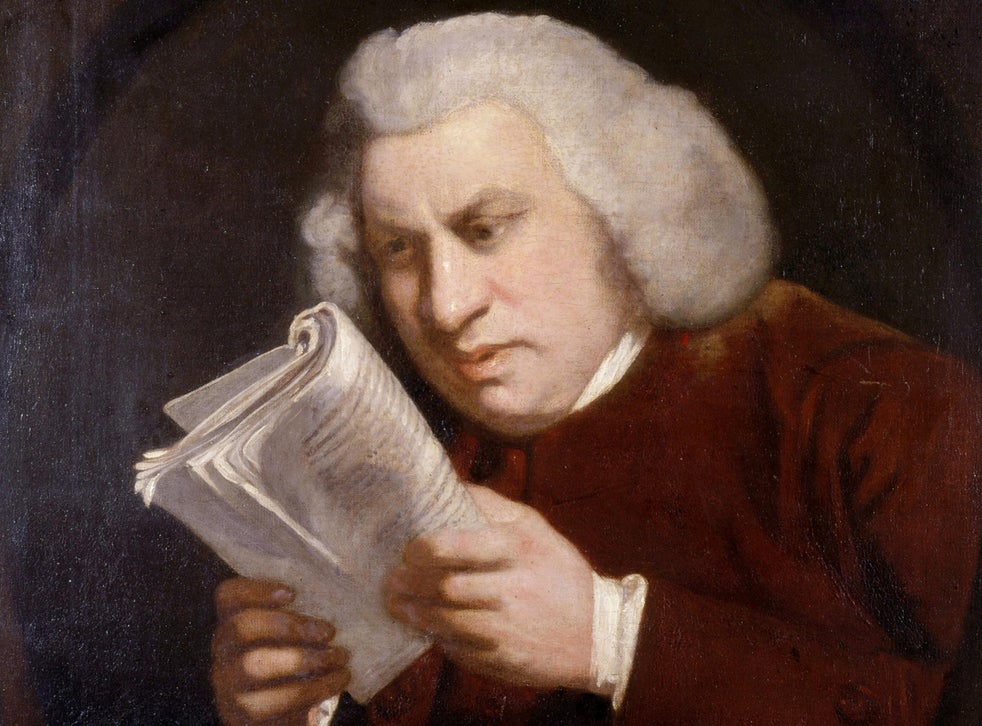
As one of the most quoted figures in English literary history and the creator of the most famous English dictionary, I wonder what you would make of current times. What words would you have for us?

By current I mean 2020. 236 years have elapsed since you passed away. Your dictionary has been updated and updated. Language doesn’t stand still; it flows. And is a mirror of its time.

2020 is certainly re-shaping the daily dictionary. The word ‘unprecedented’ is enjoying unprecedented use. And terms such as ‘self-isolation’ and ‘social distancing’ are now in the daily narrative. I wonder how you would define a ‘hand sanitiser’? I suspect that you would probably apply a verbal sanitiser to the expression: ‘new normal’.

Was ‘lockdown’ in your first dictionary? (I know that ‘aardvark’ wasn’t. Nor any word beginning with X). Or ‘Zoom’? ‘Quarantine’? ‘Outbreak’. ‘Pandemic’?

Yes, you would take great interest in the words of our current world.

A genuine celebrity of your time, your sayings resonate as strongly as ever. Your witticisms, take-downs and one-liners are legendary. One for almost every situation.

Integrity without knowledge is weak and useless, and knowledge without integrity is dangerous and dreadful“, you warned. And elsewhere quipped that “A fly, sir, may sting a stately horse and make him wince; but one is still an insect, and the other is a horse still“.

Samuel Johnson: Who was he, and why is he so important to the English  language? | The Independent | The Independent
Dr Samuel Johnson

As we travel in unsteady times, I remember your encouragement:

Life affords no higher pleasure than the surmounting of difficulties”. 

These are difficult times, for sure. And, in our corner of the world, we are having to find solutions to new challenges every day. The children in my school continue to display wonderful energy, as well as good-hearted acceptance of the measures we have in place to keep them, and our staff, safe. Equally, there is abundant positivity. My colleagues do wonders daily – and defy words at times.

As you wisely observed, “A man’s [by which you meant person’s] mind grows narrow in a narrow place.”  I see Shrewsbury as a place of breadth in all things. And these times demand wide thinking, not narrow minds. 

The word most used in 2020 is a new one. Coined by the World Health Organisation – something that certainly didn’t exist in your day. Covid. So far this year, this new word has been used in print more than any other in the English language.

You wisely advised: “None but a fool worries about things he cannot influence”.  As we move through difficult times, we will heed your call to focus on the things that are within our control.  In my case, that is giving the pupils in our care the best environment and challenge that we possibly can. And urge them as you did:

“Curiosity is one of the permanent and certain characteristics of a vigorous intellect”.

Curiosity and stickability. (Another word for your dictionary, Sir.)

Yours in words.

Leo

Letter written on 18th September 2020 – your 311th birthday.

Dear Jeremiah

Featured

You and your kind seem to be everywhere.

If we spend any time following the news media, we know how much has been said about education.  About the process of awarding grades; about the fairness or otherwise of our education systems; about the process of re-opening schools.  So much of it negative.

More broadly, the reality of COVID-19 in the UK and across the world has utterly dominated.  Understandably. And with good reason. But, this dominance has meant that we have all got used to living with some very negative narratives.    

We have been living with a pervasive language of limitation; a language of blame; and a language of fear.  This must have had an impact on even the most upbeat of people. I think we need to work hard to reclaim a language of possibility; a language of responsibility; and a language of hope.   

The language we use – the way we frame things – will have a direct effect on the children in our care and indeed all with whom we spend our time.  We need to find a way back to more positive language.

To illustrate: let’s consider the example of a child who has climbed a tree.  And got stuck.  She is getting panicked; holding onto a branch.

There is an adult below who calls up to the child. He thinks about what to call out: “Don’t let go!” or “ Hold on tight!”

Which is more likely to encourage child to cling on until she can be reached and brought safely down to earth?

  • Don’t let go!
  • Hold on tight!

Surely it’s the latter: Hold on tight!  Because negative commands and prohibitions can become fixating – paralysing even. In this particular case, ‘Don’t let go!’ reinforces the fear of falling. ‘Hold on tight!’ reinforces the hope of staying safe.

Hold on Tight!
Photo by Valeriia Miller on Pexels.com

The news media will continue to frame its language as it chooses. I suspect that the negativity, the fear and the blame will continue for a while yet. Of course, there’s a lot to think about and we need to be conscious of risk. The world needs its mixture of pessimists and optimists. We need the optimists to build the aeroplanes; and the pessimists to design the parachutes.

This is a simple but necessary point about the negative effect of negativity; and the positive effect of positivity. It’s time to lift the mood, Jeremiah.

In schools, as we welcome the children back from a long time of separation, it is important for us to assume a language that is responsible – but is framed as positively as possible. Things are getting better; we are more in control. It is vitally important for the children in our care that we are affirmative in how we present and interpret daily life. 

This doesn’t mean having our heads in the clouds.  It is a matter of affirmative presentation. In education, we should be holding on tight to the excitement and optimism that flow freely at the start of a new academic year.  Even if we are starting in a time of limitation, we should focus our talk on all the possibilities ahead and let go of the negativity.

Dear Gavin

Featured

This is an update on your examination in educational leadership. This is being conducted by continuous assessment. There are no specimen or past papers: this is a new specification. Examination conditions have been altered due to lockdown. You may confer as much as you like.  There are no easy answers.  There are are many invigilators.

You may not re-sit. However, adjustments can be made to your answers at any point. You may not appeal your result. Yet. You may withdraw at any point and allow a substitute to complete your examination.

Your interim provisional result status has been assessed by a panel of experts and non-experts. You are currently below the pass mark on the following key areas of this new specification:

  1. Communication
  2. Decision-making
  3. Fairness

The assessment is nearly complete. You are still able to adjust your answers in light of your assessors’ comments. Even at this late stage.  

We are aware that you are taking this assessment under extraordinary circumstances. You may submit a special consideration form.  An algorithm will then be applied in calculating your final result.

Time to reflect, Gavin.

Dear Upper Sixth Leaver

Featured

A message to the U6th (Year 13) pupils at Shrewsbury School, June 2020

Dear Upper Sixth Leaver

This is not how we planned it.  None of us imagined that your final term would be spent in bubbles of isolation.  None of us thought you would be saying goodbye to the school through a screen.  None of us thought that when you went home in March, you were leaving for good.  There is no way to dress this up and make it look nice.  This is not how we wanted it to be for you; and it is really very sad.

Some of you have been Salopians since joining the School in Third Form; others joined in Fourth Form; and others still became members of this community in the Sixth Form.  Each one of you is valued; each of you has had experiences here that will shape and stay with you for life.  Each one of you has been part of a house, teaching sets, sports teams, activities, ensembles, friendship groups.  Each one of you has contributed to the richness and vibrancy of this School.  Each one of you is a Salopian.  Each one of you deserved a better ending.

This year, you have shown extraordinary qualities and never more so in this last term.  You have embraced the new normal.  You had to absorb the news that the public exams to which you had been working for 18 months were not going to happen.  You had to decide how to play the summer term in remote.  You could have disengaged.  You could have been half-hearted; cynical; dismissive.  Instead, you chose to be positive.  You chose to turn a disappointment into an opportunity. 

You kept going with your academic learning, running a race knowing that the finish line had been removed.  You showed a proper love of learning.  Then, we launched Shrewsbury U and the ILM course for Young Leaders.  Again, as a year group, you seized this with both hands and the vast majority of you have participated, engaged and kept your minds active. This will stand you in great stead for whatever comes next. Well done indeed and thank you for all your endeavours.

We are now entering the final fortnight of the term.  Normally, for the Upper Sixth, this is a twilight zone of post-exam fun, communal relaxation, soaking up the place before the finale.  This has been denied to you.  Again, there is no way of making this anything other than it is: a huge disappointment.  None of us wanted you to be living out your final two weeks of school from home. 

The Housemasters and Housemistresses, your tutors and your teachers, are thinking of you.  They are in touch and wanting to do all they can to connect with you share memories of your time here and to celebrate with you.  There is no way of replicating the kinds of real experiences they would like to offer, but they are doing their best and I know you appreciate this.  And, as we move towards the end of term, our Virtual Speech Day aims to give you the very best send-off that we can right now.

Beyond that, you know that we have made a commitment to give you all the chance to be together here at Shrewsbury for a social gathering at which you can share memories with fellow pupils and staff.  We don’t yet know when that will be; the Heads of School have taken your views, and the message we have is that you want to wait until we can do something properly.  We will honour this commitment.

I often say that it is the Upper Sixth who set the tone of the School for the pupils.  This is so true this year – you have done it brilliantly.  Even in remote, this positive tone cascades and permeates through the year groups.  You have been real leaders in so many spheres of school life.  

The Heads of School and their Deputies have continued to guide and shape this term with their dedication, positivity and generosity of spirit. 

Each leaving year group hands on the torch to the one that follows it. Your year group will have a unique place in Shrewsbury history. You have lived through unprecedented times: ‘the year they didn’t do exams’; ‘the year they weren’t at school for the summer term’.

But: we will not remember you as the year that ‘did not’. We will remember you as the year that ‘did’.  You did manage the most exceptional of times.  You did stay together.  And you did the School and yourselves proud.

As each of you prepares to leave Shrewsbury, remember that the School is here for you – for life.  We are all proud of you. You are the year group that did.  And you will go on to be people who do. 

Once again, thank you for all you have given to Shrewsbury. 

See you again soon. 

LW

Dear Myrtle and Maud

Featured

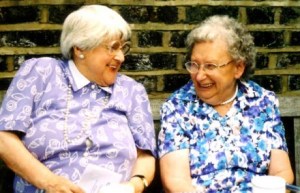
You don’t know me – but you met my wife recently.  You probably won’t remember.  She came to see you in the care home you share with about 30 others.  She was wearing greens and a mask.  You made her feel very welcome: you offered her a cup of tea which she couldn’t accept.  She told me a little bit about you when she got home.  Nothing personal or confidential, of course.  She just said that you were wonderful friends.  And told me how you kept each other going.

One of you is 92 and the other is 94.  I can’t remember which way round.  You sit together most of the day, in comfy chairs in a large sitting room with a decent view of the garden.  You tell each other stories and share memories.  You are not the best listeners, if we’re honest.  But you are great story-tellers – and the best of friends.  You cackle at each other’s jokes; you make mischievous comments about your fellow residents; you play little tricks on your carers.  So they say, anyway.  All to pass the time, which you do cheerfully, and always together.

Truth be told, you seem to have a lot of the same conversations.  If one of you goes out of the room, and returns ten minutes later, you greet each other like long-lost relatives.  And loop back into a familiar conversation.  Like an old juke box on free play.

Like an old juke box on free play.

It seems that you both struggle to remember things from the here and now; from this hour to the next.  But longer-held, deeper memories abound.  And you share them with each other freely.  And often.  The past is more present than the present.  Who knows how much of it is real memory; how much is made and re-made in the telling?

There is a danger here.  I am treading a very thin line.  I want to go somewhere that threads its way safely between the ankle-breaking rabbit holes of sentimentalism or pity or projection or just being condescending.  I may get my foot stuck and be guilty of these and more.  I hope not.  But if I am, I sense that you would forgive – and forget.  

You see, I imagine your talk as a kind of charm.  I picture it casting a safety spell around you.  I see your joyful daily endorsement of one another turn solid; a talisman against – whatever.  Are you aware that there is threat outside the enchanted circle of your chat?  Who can tell?  You don’t seem to be fearful.  Not of anything.  Instead, maybe the diurnal rituals of shared remembering insulate you from the harder truths of the present.

Others around you are exposed.  By their knowledge or their ignorance.  You are exposed too.  Yet, you seem to move together in a different place.  One of dignity and innocence; of knowing insouciance.  In this state, I see your vintage minds shining bright with hope and love and laughter. 

Are you sheltering in some woozy, magic kingdom?  Are you hiding there together?  No.  If you are hiding, it is in plain sight of extinction’s alp.  There: I see you rambling on together – equipped with all the careworn kit of the years – cheerfully talking your way across the rocky ground beneath that final incline. 

The phrase ‘Extinction’s Alp’ is taken from from Philip Larkin’s ‘The Old Fools’

This is guesswork, of course.  After all, you were just a 30 second comment.  But you lit up my mind in that short time. 

What I imagine, from this brief window, is two lives wound around each other in a shared present; two friends bound by talk that is potent with memory.  I imagine the two of you together in your chairs side by side.  I picture you laughing.   

And I wish you protected. 

Leo

PS I hope you don’t mind that I changed your names.

Dear Video-Conferencing App beginning with Z

Featured

A few months ago you were quite something – but mostly quite something that Fortune 500 companies, management consultants, international businesswomen and tech dudes did.  Born in 2011, massively profitable in 2019, you certainly moved fast.  Z by name and Z by nature. Now, everyone seems to be talking about you – and through you.

I’ve got used to your sign-on routine; learned the rules of engagement.  Using you for work has become second nature in these days of remote working. For me, work is school. You’ve rapidly become indispensable to us: teachers can teach; pupils can learn.  Pastoral care in remote is so much more meaningful if you can see you tutor group; your year group; your housemistress.  Headteachers can do the mysterious things we do: and we do love a meeting.  I can host and attend meetings to my heart’s content; keep in touch with colleagues across the country who are facing the same questions that I am; I can connect across the world. 

A rather handsome chap doing a Z… meeting

Through your neatly-squared gallery, families and friends are quizzing, celebrating, catching-up, checking in, keeping an eye out for each other.  What greater service can you offer than a means to connect people in these disconnected times? 

Yet, your detractors (rivals?) called you malware.  I’ve been called plenty of things in my time, but never malware.  That must hurt.  Seriously, we did need to check this out and put sensible risk assessments and safeguarding measures in place for use in schools.  This is to protect children and teachers alike.  So, we use your excellent record facility for all our live lessons, for example.  Everything is open to misuse, but we think what you can help us do is well worth the carefully mitigated risk. 

Teaching works well enough if the lesson is well planned and the teacher throws endless energy at it.  We’ve found that short and sweet is better.  And don’t try to collaborate: you seem to work best in a formal, bilateral, conch-holding kind of way. 

The main thing you’ve given us is a way of keeping in contact face to face.  For those of us who live and work in boarding schools, the sense of community, the reality of being together, these are the things that fuel our purpose.  Inevitably, these times in remote have pushed us apart.  You help us to be together apart.

Can I be honest with you, though?  You can have too much of a good thing…  Reading non-verbal signals is exhausting.  Seeing my face talking back at me is unnerving.  Going seamlessly from one session to the next is frazzling.  The ‘celebrity squares’ on the screen make the eyes boggle.  There’s so much to read and interpret in miniature. One day I used your excellent services for 14 different meetings.  All I could manage at the end of that was a sub-verbal grunt. 

Overall, I’m a big fan: a convert.  Like most things in life, you work best in moderation.  Thank you, Z….  You’ve been a revelation. 

And the most cathartic feature of all your many qualities?  The ability to put all your participants – let’s say a collection of headteachers, for example – on mute.  What a blissful silence that is

Thank you, Video-Conferencing App Beginning With Z.  Now, it’s ‘Leave Meeting’ from me.  I need to catch some screen-free Zzzzzzs.

Dear Cricket

Featured

This is a love letter.

You know the old saying: ‘Out of sight, out of mind”?  Well, that couldn’t be further from the truth for me.  The longer you are away, the more I miss you.  Every saying has its opposite.  With you, it’s definitely a matter of ‘Absence makes the heart grow fonder’.

It’s just not the same without you.  Summer is on its way and the stage is set.  And yes, of course, I completely understand why you can’t be here.  It’s not your fault.  You are a stickler for the rules and are rightly taking your responsibilities seriously.  I know we need to do the right thing and stay apart.

My head tells me this.  Of course, it does.  But my heart?  It longs for you.

I miss the sight of you.  The theatre of green in which you play out your many acts.  The drama of each moment, rich with potential, as something might happen, or not, with the very next ball.  The eager mobilisation of the players, white-clad on the green grass, at the end of the over.

I miss the sound of you.  The thud of ball on ‘deck’; the solid ‘thock’ of willow on leather that sets off a soothing ripple of applause.  The charged, low rev, anticipatory silence between balls.  The slow-moving silence of quiet overs, where sleep seems just around the corner.  The eruption of a wicket.  The sporting greeting of seeing a new adversary to the crease.  The push and pull of players calling to each other.  ‘Come on buddy’.  ‘Next ball’.  ‘Nice areas’.  You can be quite noisy too.  Remember Saturdays at Headingley.  Quite the party animal…

I miss the shape of you. Whether it’s the Friday night friskiness of T20 or the sedate Sunday best of a test.  Or on your days off, casually attired in the back garden.  You look great in anything, really.  I was looking forward to seeing you in your new Hundred get-up. 

I miss the smell of you.  Cut grass.  Linseed oil.  The occasional waft of beer or ice cream on a gentle summer breeze.  Other people’s fancy picnics.

I miss the way you talk.  All stats and facts; and poetry and jokes and random diversions; the idle chat; the shared speculation. 

And, your greatest charm: uncertainty of outcome.

View of the playing fields at Shrewsbury. A perfect setting in which to watch and play cricket.

It’s true, I’m remembering the very best of you.  The perfect days we had together.  You do have your moments: rainy days when the covers stay on and you refuse to come out to play; dull days when you can’t find a way to make life interesting.  Honestly, though, those grey days don’t linger in the memory. 

And until you do, I’m going to read your old love letters.  I shan’t dwell on the difficult days.  I’m going to look at photos and films of what we did last summer.  Lord’s, then Headingley.  Wow.  Or our trips to Australia – say, Melbourne 2010?  Other happy times at home: Edgbaston or Old Trafford in 2005.  Or back again to Headingley, in 1981, when we were just starting out together.  Ah, those early days… 

And so on, I’ll keep playing back the memories until you’re back here by my side.

A summer without you?  It’s just not cricket.  So, please, come back soon. 


[Written during the first COVID-19 Lockdown of 2020. A summer when there was no cricket in England – even though it is a game well-suited to social distancing!]

Dear Candidate

Featured

Watch out for the Columbo question!

You have to be pretty old to remember the detective show ‘Columbo’. A legendary police procedural that revolved around a shabby and dishevelled looking detective – Lieutenant Columbo – whose sharpness of mind was in direct inverse proportional relationship to the sharpness of his dress. Columbo used a negative first impression to his advantage, fooling the suspect into writing him off as a bumbling idiot. He would then reel his quarry in as they underestimated him; they grew casual, over-confident, sloppy. His interview technique was crafty – and highly effective.

Columbo’s best trick was to appear to have ended the interview, saying something like, “Well, I’ve taken up plenty enough of your time already”, and turn to leave. And then, just as he is shuffling off, Columbo would turn round and say, “Oh – just one more thing”. This was always the killer question – the one that caught the suspect off guard. So, watch out for the Columbo question…

Oh, congratulations on getting short-listed. Now, the interview. Could I offer a few words of advice for you to take or leave?

First up, it’s worth remembering that every moment is part of the interview – how you enter the building, how you interact with Reception and other staff, how you say goodbye and take your leave, how you communicate before and after the interview. It all feeds in.

Lieutenant Columbo: a master of interview technique?

Whilst I wouldn’t hold Lieutenant Columbo up as an example of how to dress for interview, I would certainly look out for and respect his type on an interview panel. In my experience, the ones who come over as tough, searching, probing, penetrating with very specific and clever questions – they are not the ones to fear. The more specific the question, the more obvious the answer they are seeking. You simply have to make a judgement as to what kind of angle they are on, and play it accordingly.

No, the ones to be very careful with are the open-enders, the ‘can you give me an example of a time when you…’; the smiling, friendly question that will give you the scope to say anything you want. This is where preparation and anticipation come in. You need to have thought of examples that show what you stand for, what makes you different, what shows that you care and are serious about your chosen course or career.

I recently spent a day interviewing candidates for a headship. It was absolutely fascinating. It’s always interesting meeting people at interview. Not just because different people take the same questions in such differing directions. You learn a lot about people even in 45 minutes in the admittedly formal and controlled circumstances of an interview. Some people make a fantastic first impression and then gradually fade away; others make a slow start and really grow into the interview; the best will start strong and keep getting better.

The reality that struck me once again is the old cliché that ‘first impressions matter’. As the saying goes, you never get a second chance to make a first impression. This doesn’t mean that our first assessments of people we meet are spot-on accurate. In fact, we are often wildly off-beam. But the fact remains that the way we present ourselves to others at the first encounter will either help or hinder us. Whether it is in the context of a university or job interview, or – most excruciating of all – meeting a girl or boyfriend’s parents for the first time, first impressions count.

Given that everyone will, at some point sooner or later, be interviewed, I thought I might share a few thoughts on the subject with you. Let’s start with some things not to do:

• Avoid being over-familiar or chatty. Two of the six people I interviewed yesterday said “How are you doing?” or “Hiya” when meeting the interview panel. It was not the right register to hit. We all need to be able to adjust our tone to the context we are in. That doesn’t mean putting on an act or being a fake. It’s possible to be yourself whilst also being respectful and formal.

Avoid fancy dress – I don’t mean Disney outfits – rather, avoid anything that is likely to trigger a negative value judgement. I’m all for individual expression and being yourself, but the interview is not the place for ground-breaking fashion statements. You want your appearance to convey who you are, for sure, but also to reinforce your sincerity and professionalism. Comedy ties are great – but not for interview. Wacky jewellery, humorous socks, political slogan badges: none of these is a good idea. Dark suits, simple single tone ties (not crazy colours) are certainly safer for interview. Shoes matter. Unless you are being interviewed by Vivienne Westwood – or you really want to make a point – you should aim to look conventionally smart – not too wild or wacky – and certainly not scruffy.


• Avoid cliché or platitudes – “I’m a people person”; “I have a passion for…”; find new ways of saying things.


• Avoid being negative about other people, institutions, systems – anything really. Nobody likes to hear negativity.


• Never lie or over-embellish – you’ll most likely get found out or have to embroider more or sound unconvincing. The best interviewees are determinedly themselves. If you feel you have to lie, you will sound inauthentic.

It’s also important to look closely at what the interviewer is doing; how they are dressed; the tone of question and the way they are responding to what you are saying. Read them as they read you. Fundamentally, it is about making a connection. This brings me to things that many experts say you should try to do (if you are able1) to establish a strong connection at interview:

• Aim for meaningful eye contact – but not in a fixed or challenging way
• Smile/show humour/enjoyment – in a way that is relevant and sincere – not loony or fake
• If there’s more than one person interviewing, scan and keep people involved – sweep the room occasionally, but try not to seem like an automated lighthouse
• Sit as still as you are able2 – plant yourself but not too rigidily; convey a sense of calmness and stillness – aim to be a swan rather than meerkat
• Be concise – don’t ramble – but do elaborate when asked; let there be silence – don’t try to fill it
• Answer the questions – don’t be a politician but do steer them to areas of strength and enthusiasm
• Give examples – ideally, think of them in advance – how have you shown initiative, leadership; learned from mistakes; helped change things etc – and make sure they are both true and positive
• Take your time when the curve ball or surprise question comes – and keep your answer to that brief

Right, my dear Candidate. I think I’ve taken enough of your time. Thank you. No, no – please, I’ll show myself out….

Oh – and just one more thing: don’t use The Apprentice as your guide for interviews. That’s entertainment, not real life. True, some interviewers seem more interested in proving their own brilliance than establishing yours, and some can be combative or spiky, but most interviews are open-ended, polite, undramatic and probably wouldn’t make great TV.

A good interview will aim to put you on a stage and allow you to perform. And in order to perform you need to prepare, to practise, to think about what you want to convey to your audience, and to work out how to be true to the best version of yourself. Because, when it comes down to it, it is you who will have to do the course or the job or impress those parents or whatever this interview is all about. You don’t want the interviewer or interview panel to choose some phoney, invented you. Just the best you.

Good luck!


  1. Note: All selection processes should always take into careful account – and make reasonable adjustments for – the genuine needs of neuro-diverse candidates; of course, we should always cater sensitively and respectfully for the specific needs of all individual interviewees ↩︎
  2. Note: As above. ↩︎

Dear ‘So’

Featured

So.

For a little word, you’ve been enjoying a very high profile lately.  Wow – you’re positively everywhere!  Indeed, it has come to my attention that you are at the start of so many sentences, you’ve become ubiquitous. You’ve never had it so good!  

All kinds of utterances seem to feature you right at the start.  In everyday speech, you seem to be the opener of choice.  Everywhere, it’s ‘so’, ‘so’, ‘so’.  How did you get to be so prominent?  You really know how to get noticed.

A few years ago, it used to be ‘Look’ that opened the batting.  Along with her partner ‘Right’.  Or, ‘Well’.  Or ‘Now, then’ – remember them?  Or even that rather clumsy fellow, ‘Er’.  Not so anymore.  They’ve become also-rans.  It’s all ‘so’ now. 

Yes, you’re everywhere, ‘so’.  In Tweets, on news interviews, in texts.  Always up there at the front of things.  So obvious you can’t be missed.  Sometimes short and punchy; other times drawn out and deliberate. Always there.

So, you see – it’s great to see your confidence, but there was a time when you used to be in the middle of things.  Holding things together rather than striding out in front on your own. 

That said, it’s important to be in the middle of things from time to time, so it is.  True, you were less prominent back then, when ‘Look’ and ‘Right’ were top of the pile.  Your celebrity status was so-so.  (Although I remember you on a Peter Gabriel album when I was at school – that was pretty big). Now, you are at the front of so much. 

Maybe… just a little too much?

Don’t get me wrong – it’s great to lead from the front.  Sometimes.  Maybe not all of the time?  Sometimes it’s good to let others lead every so often.  (Note to self, so help me!). 

Could I be so bold as to offer some advice?  A word of warning?  I wonder whether you might be getting just a little overexposed?  I just worry that, in the not-so-distant future, people will tire of you.    

Insomuch as I’m one to give advice, will you take this in the spirit it’s meant?  Certainly not a matter of urgency: just something to be aware of when you get a moment on your own.

So. Will you give it some thought?  I hope so.  You have so much to offer.  In smaller amounts.

Till we meet again, it’s so long.  (Or, more likely, not so long….)

Leo

PS I realise I’ve used you over 30 times even in this short letter.  So sorry!

Dear School As We Disperse

Featured

This is most of what I said to pupils and staff at our final whole school assembly of term due to the Government closure of all schools on 20th March 2020

Thank you all for gathering.  This is indeed a gathering and I suspect that some of you will be wondering whether we should indeed be gathering like this.  If you are asking this question, I would simply say this: we are a community and part of what holds a community together is being together.  We have been eating together; meeting together in House; we have been together in lessons and activities; we are together now as a School.  

So, this is a necessary whole school gathering.  There will be no Chapel or year group assemblies tomorrow morning: this is our last whole school gathering for a while.  There are some important messages to share with you all now, as we are moving into a different mode of activity over the coming weeks, and the remote learning programme begins on Monday 23rd March. 

We have been travelling through uncharted territory; and these are uncertain times.  I want to pay tribute, again, to you all for the way you have conducted yourselves, in particular over the past few weeks.  I also want to thank my colleagues, sitting behind me here, and all those in other places and roles in the School, for the phenomenal effort that they have been putting in to care for you and keep you learning.

Human beings don’t much like uncertainty.  We like to know what is coming next.  We may like the odd surprise – pleasant ones – but as a general rule we want to be in control of what happens to us.  We like to be in command of events.  However, we are all living in times where events are controlling us. 

Conscious that this makes us uncomfortable, I am reminded of the words of the great Maya Anglelou, who said: “You may not control all the events that happen to you, but you can decide not to be reduced by them”. 

We are Shrewsbury School and we will not be reduced by these events.  The stage we are moving into now, means that we are going to disperse for a while.  This is something that we do every holiday: we disperse across the country; we disperse across the world.  And then we come back together. This time, as we return to our families and guardians, we are not sure when we will all be back here together.  This will become clear in time, but for the moment, we become a virtual community.  What I want to emphasise is that, even though we are dispersing for the Easter period, we are still a school, still a community.  The digital age gives us multiple ways to keep in touch.  You can keep in touch with one another.  We can keep in touch with you.  

There is great strength in community and we can continue to draw strength from each other.  However, the truth is that these coming weeks and months are going to challenge us as a civilised society; and they are going to challenge us as individuals.  Much will depend on the attitude we bring to our own individual circumstances. 

Ten days ago at a similar assembly I spoke about the coronavirus Covid-19.  My message aimed to raise awareness of the need for good hygiene; civilized behaviour, civic good sense, concern for others and a ‘keep calm and carry on’ approach.  I said that I didn’t know whether School would close but I thought it likely we would be going into a significant period of disruption, with ongoing pupil and staff absence.  I said that we will be delivering a remote learning programme so that each of you will be able to continue your academic progress and preparation for summer exams.

Yesterday afternoon’s announcements from the Prime Minister and the Secretary of State for Schools told us two new things.

Firstly, that all schools in England will close their doors at the end of this week. This is country-wide.  It is part of the effort to limit the spread of the virus.  As a boarding school, we have asked your parents to arrange for you to be at home or with guardians by lunchtime on Saturday; many pupils have already headed home.  Let me clarify three things:

  • This is not a decision we have taken ourselves.  It’s a national decision.
  • The School will still be operational next week.  We have a duty to stay open for children of key workers – that includes people who work in the NHS, the police and other public services, for example. 
  • We are still open for all of you as we deliver our remote learning.

So, we are not in fact closing: rather, we are moving into a different mode, with the remote learning programme running all of next week for all pupils through to the published end of term.  In other words, we will keep you learning.  Clearly, all the other things we do together here in the co-curricular programme and house life will stop for the moment.  But learning, where practicable, will continue remotely. 

Secondly, yesterday evening we were told by the Secretary of State for education that the summer exams would not go ahead. 

I want to speak now to those of you in public examination years.  The Fifth Form and the Upper Sixth.  Yesterday was very big news.  I feel for you. You have every right to be disappointed; worried and confused.   You have taken a big shock.

I want you to be clear that this news landed with us at the same time that it landed with you.  We heard through the BBC.  I can share with you my frustration that schools were given no warning; no hint – in fact, quite the reverse – of this decision.  We were given no heads up and therefore no time to think carefully on your behalf about how we might support you for this news.  I would have liked it to be different for you.  However, these are unusual times. 

It looks pretty clear that exams will not happen as scheduled this summer. As it stands today, schools have been given no details on how GCSE and A Level qualifications may be awarded.  We don’t know yet how university and higher education establishments will make decisions on offers.  We will get this clear in the coming days. As soon as we know, you will know.

We also need to recognise that the Government is dealing with an unparalleled challenge and we need to accept that we have to be flexible, adaptable, calm and responsible.  We also need to ask the right questions and get sensible answers for you.

In the meantime, there is only one prudent message to those of you in exam years: please don’t let up.  The only sensible assumption at this point, even with yesterday’s announcement, is that you may well need to show your knowledge and skills in some kind of formal way.  It is hard to remain clear-headed and motivated when the finish line seems to have been moved or even erased.   But our strong advice is to keep your game head on and keep preparing.  Especially until more details are known in the coming days. 

There is a more profound reason for this. 

In the case of Fifth Form, whether or not you sit in an exam hall, your GCSE learning is fundamental to the next stage of your academic journey. You have been building a foundation, layer by layer, brick by brick, for the studies that follow.  No learning is ever wasted.  Nothing you have done has been lost. All your GCSE subjects develop skills that will then flow into your A Level studies. 

Some of you may even have been punching the air, celebrating, feeling that the pressure is suddenly off.  Please, think again.  Think bigger.  Most of you will be disappointed at the sense that you have done all the training but don’t get to run the race.  I get that.  We will continue to support and monitor your progress.   We need to see you continue to engage and to learn. 

So, my message is don’t write anything off; don’t underestimate the value of the knowledge and skills you have built up.  Don’t lose momentum.  Don’t switch off. 

Turning to pupils in the Upper Sixth:  I have been trying to put myself in your shoes.  I really feel for you.  What is the good news?  Is there any?  Well, we have been told that pupils should not lose the chance to go to university.  We wait to see what this looks like but there is a promise there that we expect to be delivered. 

Again, just as with those a couple of clicks behind you in Fifth Form, you need to keep on top of your learning.  You need to maintain momentum and be prepared.  We don’t yet know how university places will be confirmed and how assessments may be made.  It is hard to keep training for an event that has been changed, deferred, apparently cancelled.  But you need to keep in training. 

So, my academic message is this.  Keep to your academic programme.  Be prepared to showcase your knowledge.  And remember that this is also about momentum; maintaining the pace, focus and agility of mind that you will need to carry into your studies after Shrewsbury.

There is a broader social and personal development element too.  The final year of school is one of culmination; a rite of passage into the next stage; a series of markers to be enjoyed in the doing and savoured in the remembering.  It also a year of leadership; and mastery – that sense that you are on top of your game and yet with everything ahead of you. The bonds of friendship run deep after several years of co-travelling.  You deserve the right to earn the next stage in your journey; in most cases, that means a university place.   Perhaps more deeply, you only get one opportunity to leave School.  You also deserve to finish school well. 

I talked earlier about that fact that we are now dispersing.  And we don’t exactly know when we will be back in full session with everyone here on site.  I make this commitment now to the Upper Sixth:

We will get you together again; and we will celebrate you.  We will find ways for you to be together, to mark your time here.  We will see you off well and ensure that you end your Salopian career on a high.  Please, don’t feel that you need to create events and moments in the next 48 hours.  Now is too early.  We will work hard to make sure you have the rites of passage that you deserve.

It is my firm belief that the Upper Sixth help set the tone of the school.  You are leaders.  We look to you to see what a Salopian is.  You are absorbing a range of uncertainties.  And I don’t undervalue that.  But, there is also opportunity in all this.   

We all of us need to close this section of the term in an orderly and considerate way.  Staff have been working flat out on our behalf; we all want to say our farewells – our ‘see you soons’ – in the best possible way.

Turning to non-exam years – the Third Form, the Fourth Form and the Lower Sixth.  You too are facing disruption and a new normal.  Remote learning is now our key mode of delivery.  Inevitably, for a while, elements of our diverse programme and all that this means for us, are on hold.   You do need to keep learning and we will keep you on it.  This is a massive opportunity to get ahead and make incredibly valuable intellectual and academic progress.  Please, seize it. 

All of us need to seize this opportunity to deepen our skills; read more widely.  We don’t want to fritter away our time in an orgy of Netflix and gaming binges.  We can sue this time to become better thinkers; cleverer problem-solvers; more creative collaborators.  The Salopian spirit is one of enterprise and adaptation: we need to be true to this spirit as we enter a full, demanding and meaningful programme of remote learning.  

I have always said, and firmly believe, that school is not about the gathering of certificates.  It is about deep learning.  Now is the time to show this truth this more than ever.

Widening our focus back to the whole school, and hopefully without being patronising, or devaluing all the feelings, worries and frustrations you may be experiencing, I do want to ask that we all keep a big perspective.  And think of others as well as ourselves.    

We need to:

  • look after our physical health: staying active; getting exercise.  We may need to be inventive – loads of good creative ideas on the web
  • look after our mental health
    • try to avoid obsessive following of the news – I am going to limit myself to a couple of downloads a day; keep informed but deal in fact
    • Try not to obsess on a spiral of ‘what if’s’ – there are too many of them – we need to deal in the immediate; control what we can control; look after others health is good for our own wellbeing; we need to be grateful.
    • It’s important to connect with the natural world; get fresh air; sense the gradual arrival of spring; notice and appreciate things of beauty – this may sound a bit soft, but this is really important and good for all of us
    • We should use this time to try new things; read new books; do practical tasks that mean we produce things of value and give us a sense of positive control and growth
    • We need to help each other keep perspective and stay positive
  • Continue to observe the good hygiene guidance that we have all been given – especially on handwashing
  • You need to support your parents: they are dealing with incredibly heavy and diverse burdens themselves – they have all kinds of challenges to face.  You can play your part in so many ways.  Each of us needs to support our family.
  • We are Salopians and we are also citizens of a nation and citizens of the world.  We need to play our part.  I ask you to think about how you can actively help your local communities when you are home.
  • Finally, we have an overriding civic duty to follow Government directions on social distancing; protecting the elderly and the vulnerable; behaving responsibly; taking only what we need; thinking of others; and helping to slow and limit the spread of COVID-19.

So, to close.  

We are social animals and we will miss being together.  These times will test us all.  Stay in touch with each other – and with the School.

This place has been around a long while and it is not going anywhere.  I live on site and so do 70 of my colleagues.  Many of us will be in and around School throughout the Easter period.  Next week we will be delivering the remote learning programme and planning for delivery next term.  This term’s formal learning concludes at the end of Friday 27th March.  A core team will keep the school open and running as necessary and appropriate over the Easter period.  Our commitment is that the summer term will start on 21 April and that we will all re-start then, most likely with our remote learning programme.

This is a time for each of us to show what we are made of.  Our school motto tells us: “Intus si recte, ne labora”.  If right within, worry not.  It seems right to ask – what does this actually mean, now, here, in these unprecedented times?  I think that it means that we need to show character.  We need to live out our Salopian virtues: to show wisdom, kindness, courage, integrity, self-mastery, and spirit.    We are a community of learning.  And we will continue to be a community of learning in the weeks and months ahead.

I’m deeply proud of the people you are; and the people you are becoming.  Try to find opportunity in these unsettled times.  Keep learning.

I wish you and your families well.

We’ll stay in touch.

Floreat Salopia!

Dear 2020 – Day 82 (Mothering Sunday Update)

Featured

Well, 2020. You certainly turned out to have a nature only a mother could love. Fires, floods and now this.

I write now at the close of Mothering Sunday. Reading now what I wrote then, when you were 9 days old, I wince. I wished you dull. I wished you fairer, kinder, more happy than your siblings 2019 and 2018. Look at you now? 82 days old and so hard to love.

Recalling my wide-eyed, new-year wish-making, I find myself curating a curious mix of shame, defiance and hope. Like a parent, I can see that you are not living up to expectations; like a parent, I fear for you; like a parent, I regret the way things are going. And yet, like a parent, I cannot give up on you. Even as you continue to behave so badly. Or so it seems.

You are far from ordinary and the big stories of your life so far have been nothing but horror. You have a lot to answer for and there is so much you could do better. But, there is so much about you that is admirable and good. So much ordinary kindness and extraordinary courage that your acts and errors are requiring from people across the globe.

Yes, you are far from dull. And you have a very dark side. Below is what I said back when you were tiny, just 9 days old:

Welcome to the world, new-born thing. I hope you find your feet quickly. And I have some other hopes for you too. Your older sister, 2019, was a fiery one. Capable of so much good, but full of contradictions and often quite disagreeable. That’s teenagers, I suppose. Mind you, she was nowhere near as confounding and unpredictable as her older brother 2016. You never knew what was coming next with him. I wonder how he looks now, four years on.

Anyway, after 25 years of teaching, and 16 years as a parent, I know not to judge one sibling by another. Each child is wonderfully, bracingly different; unique individuals with promise and potential; needs and demands; fears, expectations and hopes. The poet Philip Larkin wrote a poem to the newly born daughter of his friend, Kingsley Amis. He wishes her something “none of the others would”. Instead of wishing her beauty, talent and love, he says: “May you be ordinary […] In fact, may you be dull.

My hope for you is like that of Larkin. You’ll have your moments, for sure, and as with all your family, there will be sadness, despair, loneliness – horror even, sad to say. But… I hope that the weight and volume of all the unseen good, and the plain day-to-day ordinary that you think and do, all this stuff will be the thing that truly defines you. I hope you are fair: or at least, fairer than your forebears – gradually but meaningfully fairer. And kinder too.

There are lots of other things I hope for you, new-born thing. But Larkin’s odd and surprising incantation says it so much better. He wishes balance and ordinariness. A life more ordinary: “If that is what a skilled, / Vigilant, flexible, / Unemphasised, enthralled / Catching of happiness is called”.

Having re-read these words, despite all the chaos, confusion and despair you’re causing 2020, I still have hope for you. Alongside the awful, there is still the wonderful. There is even some unintended good coming from your most troubled acts.

Life with you is anything but ordinary, 2020. For so many, it must feel like day after day of creeping horror. This is a crushing truth: you are doing so much harm.

And yet; and yet. Despite everything you’ve done so far, I stand by my hopes for you. There is good to you. And, like a parent who can somehow always see the good in its errant teenager; can still sense the virtue amongst all the vice; the kindness in the carnage: I’m sticking by you.

Still hoping, 2020.

Leo

Dear Detectorist

Featured

Can I set the scene? It’s a beautiful English summer’s day.  We’re on a sandy beach in North Yorkshire.  It’s one of those rare, ultra-calm, windless days when sound travels with exceptional clarity and everything feels close, and yet distant, at the same time.  

There are several families on the beach, climbing on the rocks, building sandcastles, skimming pebbles into the sea.  The air is perforated with the shrill cries of children on the beach and those of the circling seabirds overhead. 

A group of canoeists paddles into the bay and beach their canoes.  About 10 of them sit down on the beach and produce a lavish and unlikely picnic, cracking open bottles of beer and reclining in wet-suited splendour, looking, from a distance, half-human, half-seal.

On the cliffs we can see nesting gulls.  There are bird-watchers toting binoculars and draped in bits of kit. There to spot anything with feathers.  Crowds of twitchers along the clifftop, angling their necks and pointing their bins to capture the plummet of the gannet; the serene arc of the curlew; the rock-hopping of the oyster-catcher; the busy aeronautics of distant puffins. 

The tide is at its lowest, so you can clamber all the way through some of the caves and reach the open see the other side.  The rock pools are populated with anemones and seaweed.  There are barnacles aplenty on the craggy rocks.  With a firm stab of a booted foot, you can dislodge a stubborn little arthropod, inspect its inner workings, emit a noise of fascinated disgust, and carefully reinstate them on the rock.  You can look for crabs in the rock pools. 

Then, a new couple comes down the steep steps carrying two metal contraptions.  Those of us already established on the beach are giving them the once over. Gently sizing up the new arrivals, as they rattle their way onto the strand. We reckon that they are mother – probably in her 60s – and grown-up son – around about 40.  We surmise that he’s single, quite possibly still living in the maternal home.  Something about his clothing suggests that: the saggy luminous orange kagool zipped up despite the clement weather.  Beige trousers that are just a bit too short in the leg.  And, the footwear: a frightful public union of sandals and socks, so often the preserve of the unattached.

Saying very little to one another, each puts on a pair of chunky red head-phones.  They plug the lead into their devices.  And off they go.  Pacing – slowly, methodically – up the beach.   Sweeping their instruments before them.  Immediately engaged in their work.  Immersed.  Listening intently for a ping – a ping that would signal the confirmation of metal. Occasionally they stop; put the metal detector to one side; and dig with a small trowel in the sand.  And turn up something, nothing.  Something and nothing.

They do this for an hour and a half.  Gradually, the pair becomes the object of most people’s attention.  As we all keep a casual eye on them, questions gently mount in the mind, like sand passing through an hourglass.

Eventually, idle curiosity grows into something more urgent and we have to break the silence.  Someone goes over to address the pair.  “Have you found anything yet?”.  The man, to whom the question was directed, jumps in surprise.  “Sorry!”, we say.  “Didn’t mean to shock you….  Have you found anything?”.  Probably an annoying question to poke into this unwelcome break in his focus.  “Not yet”.   It’s clear that conversation is not high on his agenda for the day.  “What’s the best thing you’ve found?”, we persist. “Found a Roman coin once. Gave that in.  Mostly it’s ring pulls ‘n shot gun cartridges”.

So, let’s get this straight. You spend all that time looking and you only get to keep the things that aren’t worth anything. “Yes, that’s about it”.

All pass-times can seem a bit clubby, a bit geeky to the uninitiated. But it’s fair to say that metal detecting would probably come in quite low on a league table of activities that command instant respect. Adrenalin sports would top that table: base-jumping; parkour; free-climbing. These are high impact activities where adventure, movement and risk are the chief gods.

Your deities are different.  The gods of metal detecting are method, patience and luck.  It is a ritual of hope.

An archaeologist will likely bristle at the sight of you.  Others might disparage you as funny, slightly deluded individuals grubbing about in largely fruitless isolation.  I’ve never done any metal detecting but there’s something rather wonderful about the sight of you.  The undiluted focus, the obsessive fascination, the hermetic zeal of the activity.  Something meditative about the gentle hovering of the detector disc above the ground, its faithful attention fixed on the floor, as you guide its slow, sweeping motion. 

You and your metal detector are bound in a mutual and private search.  You seem so focused on the detecting work, so insulated from other events, that I could easily imagine you walking with steady confidence off a cliff – still listening for the jubilant beep.

Why do you do it?  Is it because you’re looking to find that special find?  Or because you are part of a citizen scientist movement, democratising knowledge and encouraging a love of heritage. Or, do you do it because the process of looking is, in itself, a pleasant, addictive, even life-enhancing state? Metal detecting, like fishing, is about waiting. 

So, I’m putting aside any sniggering assumption that people who use metal detectors should be pitied or even derided for their dodgy clothing and apparent lack of social skills. I’m going to park the idea that your type are acquisitive Golums, addicted to antique shiny things; or rural bounty hunters methodically stripping the land of its precious little secrets. Maybe you detectorists are ok. Oddly cool. Maybe even role models.

As an activity, metal detecting requires patience and method.  It encourages the constant readiness for discovery; the acceptance of simple labour in the pursuit of some ecstatic moment, a chance unearthing of something really interesting, really valuable.  Like all the best hobbies, metal detecting stands on a central foundation of futility.  And the infinite resurgence of hope over experience.

If I’m feeling poetic, I could see your metal detectors as instruments of hope. Ok, they may not be style magnets but, viewed in this way, they are images of the human being’s desire and determination, to search out truth and beauty, and to continue to hope that truth and beauty do indeed lie out there.  Truth and beauty are often to be found buried, obscured by the accumulated silt of other, less remarkable things.

All the great thinkers and spiritual leaders have emphasised the need for hope.  We know that human beings are capable of acts of ugliness, cowardice and falsehood.  These thinkers hold us firm to the belief that, as individuals and as communities, human beings are capable of great beauty, courage and truth.  And that these great universals can be unearthed in all kinds of places; in all kinds of interactions with others. 

Presumably, detectorists are afflicted by finite disappointment on a routine basis.  It’s part of the process.  But you seem to be powered by infinite hope. Maybe you detectorists aren’t that odd after all. 

Maybe I’ll follow you up the beach and see what I might find. Or not find.

Leo

Dear Gerald

Featured

News of your passing has reached me.  You went out smiling, I’m told, and at the very decent age of 81. 

You worked all your life at the same school.  As a caretaker, odd-job-man and general lifter-and-shifter.  You spent over 50 years serving the same school community.  Same in name, but – like a river – always changing and flowing forward into different times with different people.  Yet, you were a constant. 

I remember you from when I was a child, growing up with a teacher for a Dad, in a boarding school where the staff children roamed free in the holidays.  And during term-time, our teacher parents were busy looking after other people’s children.  You were one of the benign constants that held us gently in place.  You were an ever-there. 

With your trademark greeting, unerring in your cheerfulness, you would say to all you met: “Lovely to see you!”.  You’d bellow that greeting in advance from a distance; or boomed it as a valediction – a validation – as you rolled along to your next task, your next greeting.  You were utterly indiscriminate – in the best way.  You showed no judgement.  Yet this greeting did not feel cheap or empty.  It was a simple, joyful affirmation. Your famous wheezy laugh fizzed with gentle mischief.

You wore blue workman’s dungarees, with splashes of paint and oil and grease, over a white string vest (have I made that up?) and always, whatever the weather, a bobble hat.  Yellow, was it?  And lacking the bobble.  

One time, you dropped a large metal radiator on your foot.  It landed like a heavy blade, taking one of your toes off in your shoe.  You wrapped and carried it like a little bug in your huge hands, searching for someone to help you.  The first person you met was my Dad.  He drove you to the hospital and kept you talking.  Something you did willingly, as if you were sharing a routine trip to the shops.  They patched you up somehow.  And you never forgot the kindness. 

From time to time, some of the children at the school would try to find fun in you.  You defused their nuisance with your constant greeting and undefended heart.  Soon, everyone knew that there was no fun to be had in setting traps for you.  Rather, they saw that you were a treasure; an institution; a legend.  Your loyalty; your appetite for hard work; your unearthly strength; your trustworthiness; your sheer reliability: these were qualities that even the most bone-headed of us could see were golden virtues. 

Love came from what you did; and love was the source of it.  And you were loved for being you. 

Rest in peace, Gerald.

Lovely to see you.

Leo Winkley

Dear 2020

Featured

Dear 2020

Welcome to the world, new-born thing. I hope you find your feet quickly. And I have some other hopes for you too.

Your older sister, 2019, was a fiery one. Capable of so much good, but full of contradictions and often quite disagreeable. That’s teenagers, I suppose. Mind you, she was nowhere near as confounding and unpredictable as her older brother 2016. You never knew what was coming next with him. I wonder how he looks now, four years on.

Anyway, after 25 years of teaching, and 16 years as a parent, I know not to judge one sibling by another. Each child is wonderfully, bracingly different; unique individuals with promise and potential; needs and demands; fears, expectations and hopes.

The poet Philip Larkin wrote a poem to the newly born daughter of his friend, Kingsley Amis. He wishes her something “none of the others would”. Instead of wishing her beauty, talent and love, he says: “May you be ordinary […] In fact, may you be dull.

Well, 2020. You are 9 days old as I write this and there is no danger of you being dull. At least, that’s what the news suggests. Of course, there’s lots about you that will be mundane, ordinary. And, indeed, good. Particularly when lived and viewed from this safe corner of the world in Shrewsbury.

My hope for you is like that of Larkin. You’ll have your moments, for sure, and as with all your family, there will be sadness, despair, loneliness – horror even, sad to say. But… I hope that the weight and volume of all the unseen good, and the plain day-to-day ordinary that you think and do, all this stuff will be the thing that truly defines you. I hope you are fair: or at least, fairer than your forebears – gradually but meaningfully fairer. And kinder too.

There are lots of other things I hope for you, new-born thing. But Larkin’s odd and surprising incantation says it so much better. He wishes balance and ordinariness. A life more ordinary: “If that is what a skilled, / Vigilant, flexible, / Unemphasised, enthralled / Catching of happiness is called”.

May you be dull, 2020. May you catch more happiness.

Yours in hope

Leo Winkley

Plain Gobbledegook

Plain Gobbledegook

Not so long ago, I was sitting on a train back from Manchester in a half full (or, if you’re that kind of person, half empty) train carriage. Coach B of the Arriva Trains Wales Express: a two-carriage number that grinds its way from Manchester all the way down to Carmarthen.

As is the way in this country, there was an instant (and literally unspoken) agreement amongst all the travellers in Coach B of the Arriva Trains Wales express – that there would be no talking. Accordingly, after the train guard has done his announcements, the carriage fell into silence and we were together alone in our moving metal carapace.

‘Travel silence’ is something that we do very well in this country. If you sit on a train in Spain, Italy, India or the US, for example, it’s a-buzz with chat and noise. In England, there is a strict and unspoken traveller’s code: only mad people, drunks and foreigners speak on English trains.

So it was that a culturally-binding silence settled over Carriage B. At each stop this hush was briefly perforated by the incomprehensible, tinny announcements from our train guard; white noise that barely roused us from our private inner worlds.

Then: a phone rang. A few of us scrabbled about to check if it was our phone. (Everyone over the age of 40 seems to have the same ring tone these days). Anyway, the silence was then broken for several minutes as the recipient of the call conducted a lengthy business conversation.

Well, you all listen in, don’t you? It’s impossible not to. Unless you’re plugged in, you can’t help but overhear. We all tend to speak-shout into our phones when we’re on a train and it’s a small carriage.

It was, in all honesty, not a very interesting conversation. A business call. In fact, it was such a dull conversation that it somehow travelled through the spectrum of dull and came out the other side, transformed into something genuinely engrossing.  It seemed that things were at a critical point in the negotiations to land a big contract.

The phone call was punctuated by a mesmerising range of professional jargon, management and business speak. A multitude of technical expressions and organisational clichés reverberated around the carriage, soaking the captive travelling audience in a sound-world of industry chat.

The high – or was it low – point phone call was the closing sentence.

“Going forward, I think what we need to think outside the box. Let’s touch base later”.

And with that the call was over.

Now, I find that sentence had quite hard to live with.  A recent survey by the Institute of Leadership & Management, revealed that management speak is used in almost two thirds (64%) of offices, with nearly a quarter of people surveyed considering it to be a pointless irritation. The top three most annoying and over-used bits of business jargon were: “touch base” (39%); “going forward” (55%); and top of the pops was: “thinking outside the box” (57%). My carriage-mate had managed to squeeze all three into the same sentence!

Now, let’s remind ourselves that I’m being a Nosey-Parker, eavesdropping on one side of a private conversation. You might also say that if you make a call in a train carriage, you deserve what’s coming to you.

All this enforced overhearing prompted me to think about two things. Firstly, about the value of plain speaking – that is, speaking clearly and free of unnecessary jargon. Secondly, about the value of speaking as a person, an individual; rather than sounding like a manual.

You can tell when someone is saying things in her or his own individual voice. The person comes through the language. The danger of management-speak, jargon, slogans, cliché is that they diminish and muffle our original voice; these over-used expressions standardise us.

Words can be beautiful, powerful things: a means of conveying such a range of sense and feeling; such diverse ideas and observations. We can use them to create fresh possibilities; we can use them to numb; we can use them to agitate; we can use them to soothe.

Most human activities – such as sports, the arts, careers – have their special languages. Think of sport, for example. These are sometimes called ‘language games’. In these games, esoteric terms and expressions resonate with the initiated; by those who understand and are part of the club.

And so it is with education. We bat around all kinds of special language; educational acronyms and shorthand abound. Schools are wonderful generators of idiosyncratic terms. The idea that we should meet in Grot and then do our Top Schools after having tea in KH only makes sense in our small part of the world.

I’m not objecting to specialised language. I’m objecting to dull and lazy language.

What became the Campaign For Plain English was started by the redoubtable Chrissie Maher OBE in 1979. She fixed her aim on various uses of language which she felt were deliberately obscure. It was a campaign against gobbledygook, jargon and misleading public information.

On the hit list were longwinded official writing; management-speak; professional jargon; tired and overused expressions; silly job titles that see ticket inspectors become “Revenue Protection Officers”, supermarket shelf-stackers go by the title of “Ambient replenishment controllers”, and teachers are “Knowledge Facilitators”. I mean, seriously?

The Campaign for Plain English (or Plain English Campaign as it now seems to be known – you can see what they did there) aims to remove these word-soups from institutional life. They want to get professionals, in particular, to speak more simply. For example, a recent educational document (not ours I hasten to add) deployed the following sentence: “High quality learning environments are a necessary precondition for facilitation and enhancement of the ongoing learning process”. What this actually means is: “Children need good schools if they are to learn properly”.

The issue here is that bureaucratic language excludes meaning – often, it would seem, deliberately. It’s important we don’t get infected by this linguistic virus. We need to find our own, distinctive voices – and delight in them.

Personal statements, for example, should be personal. Essays should be in (pretty much) our own words. We should avoid cliché and jargon but rather make the effort to use interesting and original language. This does need to be carefully done. All of us, not least Headmasters, succumb to over-embellishment and can sound pretentious, and our text (including this one) over-written. Everyone needs a good editor.

Scaling up from our day-to-day context, it is so important that all of us, especially the young, use the power of their words, opinions and voice. Salopians are polite and gentle souls but sometimes you have speak truth to power – even if your voice shakes.

It is mission-critical (is that a cliché?) that Salopians think and speak for themselves. This is a theme that we will repeat and repeat as a school. The world is full of versions of the truth; we all need to be mindful enough to de-code and challenge these versions in the post-truth era. We need Salopians young and old to challenge and to initiate change.

I have said a lot about speaking. As somebody very wise once said: “God gave us one mouth and two ears: we should use them proportionately”. It is critically important that, in the noise of populism, YouTubing and democratic broadcasting, we retain the ability to listen actively.

Active listening is not just waiting for the other person to stop speaking so we can make our much more interesting point. Only by deep and active listening do we fully acknowledge the rights and the values of the person we are speaking with. Even if we despise the views of another, we need to listen deeply to understand them.

Of course, the trick in all this, is that human beings learn by imitation. We observe, we copy. That’s how babies start talking. It’s only natural that we mimic the language of others. This is language with stabilisers. The journey our children are on (in fact we are all on), is to find their own authentic voice; to get rid of those linguistic stabilisers.

For pupils, my simple message is to speak in their own voice. I want them to be confident enough to stand outside the verbal uniform of teenage jargon. I want them to dress their language differently.

Meanwhile, back in Carriage B of the Arriva Trains Wales Express from Manchester to Carmarthen, we’re nearing Shrewsbury station. In silence. After my (albeit unspoken) righteous indignation at my carriage-mate’s choice of language, I’m feeling an uncomfortable guilt at my linguistic snobbery.

What it reminded me, though, is that language can be used to numb and neutralise. And, equally, that it can be used to ignite and enliven the mind. Each mode has its generative powers; each has its dangers.

Words have a power to reveal or to conceal. Political discourse is replete with spin and double-talk, linguistic sleights of hand and verbal finessing. The delight in language is a wonderful thing. Selective and careful deployment of what the teachers at primary school might call ‘juicy words’. It’s good to make interesting sentences and fill our self-expression with colour.

Language can be used to mislead, to obscure, to obfuscate, to redirect, to exclude. So, as in all things, there is a time for floral language, a time for using technical vocabulary and a time for plain speaking. A time to rage against cliché. A time to speak up, in our individual voices, here in Salopia and in the wider world.

Something tells me that the world needs its teenagers and young adults to speak up – and keep speaking up.

And let’s try not to use clichés. After all, it’s not rocket science….

Against cynicism

“There is nothing quite so tragic as a young cynic”. Maya Angelou.

When he rose to speak at the Sorbonne in Paris on April 23 of 1910, Theodore ‘Teddy’ Roosevelt delivered a powerful call to action against the seeping cultural tragedy of cynicism, which, in his view, was a poison aimed at the heart of a just and democratic society.  Roosevelt, who served as the 26th president of the US, cautions against “that […] cheap temptation” to be cynical.  He said:

The poorest way to face life is to face it with a sneer. There are many men who feel a kind of twister pride in cynicism; there are many who confine themselves to criticism of the way others do what they themselves dare not even attempt. There is no more unhealthy being, no man less worthy of respect, than he who either really holds, or feigns to hold, an attitude of sneering disbelief toward all that is great and lofty, whether in achievement or in that noble effort which, even if it fails, comes to second achievement. A cynical habit of thought and speech, a readiness to criticise work which the critic himself never tries to perform, an intellectual aloofness which will not accept contact with life’s realities — all these are marks, not […] of superiority but of weakness.”

One of the tendencies we might find most troubling in contemporary culture is that of mistaking cynicism for critical thinking.  This confusion seeds a pernicious strain of unconstructive and lazily destructive condemnation.  Amid this epidemic of self-appointed critics, it becomes harder and harder to remember just how right Bertrand Russell was when he asserted nearly a century ago that “construction and destruction alike satisfy the will to power, but construction is more difficult as a rule, and therefore gives more satisfaction to the person who can achieve it.”

Cynics have a jaundiced view of life. They operate from the assumption that people are motivated purely by self-interest rather than acting for honourable or unselfish reasons.  They tend to assume that anything that appears to be well-meant and for the good of others, is corruption and selfishness dressed up to look pretty.  Cynics are suspicious of decision-makers; they seek to knock things down in the expectation of exposing their corrupt foundations.  They like to negate and destroy.

Now, you might well say that a drop of cynicism is a sensible homeopathic remedy against the abuse of power and the apparent madness of our times. History illustrates that, indeed, institutions and individuals can use their responsibilities and powers to evil ends.  In this way, the part-time cynic might say that she protects herself from the abuse of power.  However, I would like to suggest that cynicism as a default setting is as imprisoning as the abusive use of power and self-interest.  It is also a lazy non-participative attitude.

Roosevelt concludes:

“It is not the critic who counts; not the man who points out how the strong man stumbles, or where the doer of deeds could have done them better. The credit belongs to the man who is actually in the arena, whose face is marred by dust and sweat and blood; who strives valiantly; who errs, who comes short again and again, because there is no effort without error and shortcoming; but who does actually strive to do the deeds; who knows great enthusiasms, the great devotions; who spends himself in a worthy cause; who at the best knows in the end the triumph of high achievement, and who at the worst, if he fails, at least fails while daring greatly, so that his place shall never be with those cold and timid souls who neither know victory nor defeat…”

Powerful stuff indeed.  Yes, as the modern world spins with shape-shifting complexity, the appeal of making a retreat into self-protective cynicism may be increasingly tempting.

In her excellent book, How to Build a Girl, Caitlin Moran, regular columnist in The Times newspaper, writes against succumbing to the temptation to recline into lazy cynicism:

When cynicism becomes the default language, playfulness and invention become impossible. Cynicism scours through a culture like bleach, wiping out millions of small, seedling ideas. Cynicism means your automatic answer becomes “No.” Cynicism means you presume everything will end in disappointment.

And this is, ultimately, why anyone becomes cynical. Because they are scared of disappointment. Because they are scared someone will take advantage of them. Because they are fearful their innocence will be used against them — that when they run around gleefully trying to cram the whole world in their mouth, someone will try to poison them.”

Ok – you do have to be a bit savvy; a bit street-wise. Not every individual is trustworthy; not every organisation is benevolent.  But, the default must surely remain with optimism.

This place, this school, is the least cynical place I’ve ever worked. You are the least cynical children I’ve ever worked with.  Ok, there can be the odd rolling of eyes; the occasional sideways glance – but I forgive you that – you’re teenagers after all! (He said, patronisingly).

And for the very most part, you raise your concerns and express your voices in a constructive spirit. See, for example, the work of the School Council, as I did yesterday, and you can admire a blend of open discussion and reasoned challenge.  You don’t have to be cynical to change things.

The staff here are the least cynical I have ever worked with. Even the longer in the tooth rarely grumble, and if so it’s mostly about sensible things.  On the whole, this is because our School encourages a constructive approach to life.  That it is better to get stuck in, than to stand on the side-lines and comment; that it is better to participate than be a spectator; that you get more out if you put more in.  That it’s easy to sit in the armchair and poke fun at others; but much harder and more rewarding to get up and do something.  That it is the creators, the optimists, the constructors, who make a difference.  That nobody ever put up a monument to a critic; and, when it comes down to it, nobody likes a smart-arse.

We must be on guard against the pernicious laziness of cynicism. Here’s to positive engagement; true critical thinking; making change happen from the inside.


[Source credit for inspiration and excerpts in italics: http://www.brainpickings.org – Theodore Roosevelt on the Cowardice of Cynicism (Accessed 8.5.2018)]

Hope as a call to action

The turn of the year can precipitate a curious compound of hope and despair.  We look back at the year gone by and review the events of our own lives, as well as those of our family and friends, and the wider world.  We might ask ourselves whether it has been a good year – for us, for our friends and family.  We might ask whether the world got a little bit better during 2017.  We might wonder whether it got a little bit worse.  Are there reasonable grounds for hope that we are always moving to a better, fairer, kinder global human community?  Or, is there more persuasive evidence that human-kind is becoming a more confused, desperate and disparate family.  

How would we measure out a response to such a question?  It might be that it comes down to our own individual temperament and outlook:  how we choose to see the world.  As one thinker remarked:  “There is no such thing as a view from nowhere”.  In other words, we all view the facts and events of our lives, the happenings in the world, though our own individual lenses.  It may be that those who see reasonable grounds for hope are, temperamentally, more hopeful, more optimistic people.  And those who see reasonable grounds for despair are inclined to see the world from a gloomier, pessimistic – they might say realistic – perspective. The old half-full, half-empty binary.

Hope, allegedly, springs eternal.  (As an Arsenal Fan I can testify to this).  This observation may say something about human beings; it may provide an answer to the question of whether it is better to live life in hope and feel oft-let-down; or whether a shrewder tactic is to reconcile oneself to disappointment and then be pleasantly surprised when things turn out well. 

To my mind, it is not just desirable, but actually our duty, to live in hope.  Hope is not a matter of outlook – a kind of wistful, fingers-crossed, ignore-the-bad-bits dreamland.  Hope faces the hard realities of life and tries to address them.  Hope is not wishful-thinking: it is a call to action.

But, how would a hopeful person answer this question: is the world a better place at the end of 2017 than it was at the start?  We might start by citing all the many very real horrors, tragedies, brutalities, disappointments, disasters and apparently chaotic turns of events.  We would soon find that we have stacked up a powerful body of evidence to suggest that 2017 was a bad year, maybe even a mad year.  And all this evidence might justifiably lend weight to the view that human civilisation is going in the wrong direction. 

I can see that.  I would not try for one second to downplay the depth and breadth of suffering – some of it born of random chance, much of it carried out through human agency.  However, perhaps because I am a hopeful soul, I find myself looking back to the many good things that occurred in the last 12 months.  I find myself thinking of the countless kind and noble acts carried out by human beings; acts of compassion, generosity, friendship.  The daily good news stories that don’t often dominate, or even penetrate, the news media.  These acts were born of the same human free will that also proved capable of wickedness and depravity.

But, is my optimistic view justified?  What evidence is there that the world got a bit better last year?  Well, my mum, who is also an optimist, shared with me a list, published by Future Crunch, of 99 global reasons to celebrate progress in 2017.

They include the following:

          In 2017, the hole in the ozone layer shrunk to its smallest size since 1988

          The World Health Organisation unveiled a new vaccine that’s cheap and effective enough to end cholera, one of humanity’s greatest ever killers.

          In 2017, the United KingdomFrance and Finland all agreed to ban the sale of any new petrol and diesel cars and vans by 2040

          In the United States’, the official poverty rate reached 12.7%, the lowest level since the end of the global financial crisis.

          On International Women’s Day 2017, Iceland became the first country in the world to make equal pay compulsory by law.

          Women now occupy 23% of parliamentary seats around the world, up from 12% in 1997.

There 93 other reasons to be cheerful in this list.  The 99 positive facts suggest progress – or at least the gradual putting right of wrongs.  Many are, of course, the flip side of deep and long-running negatives – they show progress towards – rather than arrival at – a worthy and ideal destination.  A destination at which each living being, and indeed the planet itself, is treated with respect and given the opportunity to thrive.  Behind these facts, and alongside the reality of the very many negative events of the past 12 months, there is the hard truth to face: that the world remains an intensely divided, brutal, imbalanced and unfair place.   

We can face this fact with despair; we can ignore this fact and immerse ourselves in comfortable self-interest; or we can pledge to do our bit, in hope.

There are, I believe, (and hoping not to sound trite), reasons to be cheerful.  Easy to say, perhaps, in our comfy corner of the world.  However, I would still like to believe that the turn of the year is a moment of profound hope and opportunity.  And, a time at which we can remind ourselves of a daily call to action.  That is, a call to action, born of hope, that we can, in our individual lives and in our daily actions, make the world a better place. 

International day of the girl

Benazir Bhutto was a Pakistani politician who served as prime minister of Pakistan from 1988-1990 and again from 1993-1996. She was the first woman to head a democratic government in a Muslim majority nation.  Ideologically liberal, and a secularist, she was a controversial figure in Pakistan, feared and revered in equal measure for her modernising views and charismatic leadership.

Bhutto’s political life is far too complex to do justice to in just a few minutes, dogged as it was by controversy and accusations of bribery, nepotism and corruption; Bhutto was ousted from power through a rigged election. After a period of time in opposition, she came to power again.  Although her efforts at reform and liberalisation were thwarted, her name was synonymous with democracy and she became a global icon of women’s rights.  Bhutto was respected in the west as a stateswoman of global reach and significance.

After losing elections in 1997 and 1998, Bhutto went into self-exile in Dubai from whence she continued to lead her party through proxies. She returned to Pakistan in 2007 to contest the 2008 elections.  She knew well her return to Pakistan put her own life at risk.  Bhutto was assassinated in a suicide bomb attack in Rawalpindi.  Al Qaeda claimed responsibility, although the Pakistani Taliban were widely suspected as being behind the attack that ended her life at the age of 54.

Spool forward half a decade. On the 9th October 2012, Malala Yousafsai was climbing onto a bus in Taliban-ruled North Western Pakistan.  She was 14 years old.  As she boarded the bus, a gunman appeared, asked for her by name, and shot her in the head.  She was left for dead.  Miraculously, however, Malala survived the attack.  She and her family were flown over to the UK and settled in Birmingham.  The reason for the attack, for which the hard-line Taliban claimed responsibility, was an open diary that Malala has been writing and publishing, under a pen name, arguing and campaigning for the rights of women and, in particular, for the right for girls to receive an education.

The story of her recovery – from delicate surgery at a Pakistani military hospital to further operations and rehabilitation in the UK, was widely covered in the media. Malala was discharged from hospital in January 2013 and her life now is unimaginably different to anything she may have envisaged when she was an anonymous voice chronicling the fears of schoolgirls under the shadow of the Taliban.

Malala has become an international symbol for, and advocate of, the fight to improve girls’ literacy around the world. She is iconic of the power of human will to overcome brutality and marginalisation.  In 2014, Malala became the youngest person ever to receive the Nobel Peace Prize.  This year she was made the youngest ever UN Messenger of Peace.

Earlier this week, exactly 5 years to the day that she was shot, Malala began a course in PPE at Oxford University. She is at Lady Margaret Hall, the same college that Benazir Bhutto had attended, and following the very same course.  In Bhutto’s day it was an all-women college (as it was when my mother was there); in Malala’s, it is a mixed college (as it was when I was at the same college): co-education has become very much the norm in our part of the world.

Indeed, we live in a part of the world where the idea of equal access to education is taken as read; a given. Lucky us.  The world still has a long way to go, even in our supposedly enlightened times, before we have a society where girls and women enjoy equality and fairness.

A BBC article published on 10th October listed the 10 toughest places in the world for girls’ education.  9 of the 10 countries listed are in Africa.  In the Central African Republic there is one teacher for every 80 pupil; in Niger only 17% of women between the ages of 15 and 24 are literate.  Only 1 in a 100 girls Burkina Faso completes secondary school.  In Ethiopia, over 40% of girls are married before the age of 18 – this applies across all of sub-Saharan Africa.

Yesterday (11th October) was international day of the girl.  And with over 130 million girls still out of school, the global campaign for the right of access to schooling and education for girls is as urgent as ever.  Icons such as Malala, following in the footsteps of her own hero Benazir Bhutto, can influence and draw attention to the host of issues that affect girls and women across the world: poverty, disempowerment, lack of education, sexual and physical abuse.

Who knows what things Malala will go on to achieve in her life? Because she has been exceptionally brave; because she has been exceptionally fortunate to escape an attempt on her life; because she is using her extraordinary voice to change the world; and because she knows the liberating power of a good education.

Handedness and points of difference

Studies suggest that 90% of the global human population is right-handed and 10% left-handed. This means there are about 60 left-handers in this room.  A minority group. If you are left-handed you are – well – a bit different.

It turns out that men are more likely to express a strongly dominant left hand than women. If you are a Muppet, however, it’s almost certain that you’ll be left-handed.  This is because a right-handed puppeteer (and we can assume that about 90% of puppeteers are right-handed) – they will use their right hand to articulate the puppet’s head, and the left to move the arm-rod.  So, in the world of Muppets, and other hand-puppets, it is the right-handed Muppet that is the minority animal.

Simpsons fans will have noticed that Bart Simpson– and indeed Ned Flanders – are both lefties. This may be a function of the fact that the creator of the Simpsons is left-handed – as was Jim Henson, who invented the Muppets.

Yet, despite the common terminology of “left-handed” or “right-handed”, the distinction is less than absolute. Some of us are more ‘handed’ than others.  We are in effect dotted along a continuum between strong left and strong right.  In between these extremes lie various degrees of mixed-handedness and ambidexterity.  Some of us will prefer the left for certain tasks but not others – we might write with our left hand but play tennis with our right, for example.

Interactive sports such as table tennis, badminton, cricket, and tennis have an over-representation of left-handedness. In cricket, for example, around 1 in 5 on the all-time list of international male cricketers bat left handed.

The smaller the physical distance between participants, the greater the number of lefties. In fencing, for example, it seems that about half the participants are left-handed.  Plenty of boxers are ‘southpaws’. Meanwhile, in non-interactive sports, such as swimming, we see no over-representation of left-handers.  It’s not a relevant factor.

Handedness is something of an evolutionary mystery. One of the earliest theories proposed that handedness in humans was originally evenly distributed, but hand-to-hand battle in the ancient world killed off the lefties because they held the sword with their left hand and the shield in their right, thus leaving the heart much less protected than for righties, who held the shield on the left. As the lefties perished on the battlefield, so did their genes.

A later theory proposed pretty much the opposite — that left-handedness gave warriors a competitive advantage “for much the same reason left-handed tennis players, boxers, or fencers have an advantage.”

In a book called ‘Right Shift Theory [1985], Marian Annett observes that animals have roughly 50-50 split between righties and lefties. Your domestic dog, cat, rat or rabbit has a pretty much even chance of being left or right pawed.  But, for humanity the distribution of preference and performance is dramatically shifted to the right.  Why?  This human bias was triggered, says Annett, by a shift to the left hemisphere of the brain for certain cognitive functions, most likely speech. . . .   The development of complex speech has led to right-hand dominance.

It was once hypothesized that the cultural link between left-handedness and negativity arose due to the left hand’s use for hygiene purposes in non-industrialized countries – that is, wiping your bottom. However, the association has much deeper roots, including the very etymology of the word “left”, which derives from the Anglo-Saxon lyft which means ‘weak’ or ‘broken’.

Even modern dictionaries include such meanings for left as “awkward,” “clumsy,” “inept,” and “maladroit,” the latter one borrowed from French, translated literally as “bad right.” Most definitions of left reduce to an image of doubtful sincerity and clumsiness, and the Latin word for left, sinister, is a well-known negative connotation.  There are many references to God’s right hand – not so many – in fact none that I could find – to God’s left hand.

This tells us a little about the cultural bias that has existed around handedness.  It is not all that long ago in this part of the world that, if a child showed left-hand preference, she was educated (that is, forced) to use the right hand.  I can remember a boy in my class at school called Stuart.  He had terrible hand-writing – a tiny, spidery drawl across the page that often meant his teachers got frustrated at marking his work.  The reason?  He preferred to write with his left hand but his mother was very superstitious, associating left-handedness with negative forces.  It was she who insisted that Stuart learned to write with his non-dominant right hand.  Don’t worry, he’s now a very successful businessman.  And a good touch-typist.

Why talk about left-handedness? Well, it’s a point of difference.  And, I’d like to suggest, that difference is good.  We should not only tolerate and respect difference – we should celebrate it – loudly!  What a tedious and sterile world it would be if we were all right-handed; all good at the same things; all interested in the same things; held the same views; wore the same clothes.

I’m not saying it’s cool to be left-handed, any more than it’s cool to be right-handed. In fact, often we don’t even notice.  A person is a collection of features which, when all added up, amount to something unique.  What’s cool is authenticity – being who you are and letting others be who they are.

So here’s to lefties. Here’s to the leftie in all of us – even us common old righties.  Here’s to all our many points of difference.

What’s the point of school?

These were some thoughts at the start of the new school year at St Peter’s in 2018.

This is a strange question for a Head Master to ask, perhaps – but: what is the point of school?

For the grown-ups in a school like mine, for the teaching and support staff, the school provides us with our jobs, our livelihoods, our vocations and a very significant part of our life’s purpose. Every teacher will have an answer to the question: what is the point of school?  But, what of the pupils? For the 571 pupils starting this new academic year at St Peter’s, what is the point of school?   I hope that the most immediate thoughts are things like these: to learn, to have fun, to make friends, to play, to get involved in all manner of activities.

Yet, the most obvious answer is that they’re in school because they have to be. All children have to be educated as a matter of law.  And it’s a matter of law because education is a fundamental human right and essential for the exercise of all other human rights. It is worth reminding ourselves of this blindingly obvious truth. Education empowers and liberates human beings.  This is a fact that we sometimes lose sight of in the Western world.  We can become rather blasé.  In emerging nations, there is an insatiable hunger for education as the route to a happy, independent life.

Parents in this country have a choice as to how they would like their children educated. They can choose for their children to be educated at home.   The vast majority of parents, however, choose to send their children to some version of the institution known as ‘school’.  In this country, most children attend a school that provides education free of charge – state education.  The remaining minority of parents make the choice to send their child to a fee-paying independent school.  Like St Peter’s.

Interestingly, the word ‘school’ derives from the Greek word ‘schole’, with the paradoxical meaning “leisure” or “free time”. When school was invented, it was about putting people into groups so that they could learn in their free time.  So, right at the start, we have the idea that school is about learning and about freedom.

The Revd. Dr Martin Luther King once gave a lecture entitled ‘The Purpose of Education’. Dr King summarised what he believed was the true goal of education in three words: “intelligence plus character“.  By that, I wonder if he meant that education is not only about filling young minds with knowledge and equipping them with a range of skills and aptitudes; but that it is also about developing the whole person; shaping and nurturing the values, the beliefs, the individual character of every child. “Education is not the filling of a bucket, but the lighting of a fire.” (WB Yeats).

It is, of course, hard to identify a single purpose to school. Everything is important.   Our academic learning is vital to grow our own individual intelligence to its full and varied potential, to experience the delight that comes from learning new things and acquiring new skills and, of course, to strive for the best possible outcomes in formal exams.  The certificates matter: they form the passports to the next stage.  But, just as my passport is not me – which is good news if your passport photo is anything like mine – the grades we achieve are not the full story; but they do provide the keys that open doors. With this in mind, it is terrific that this summer’s exam results at both A Level and GCSE have been very strong indeed.  This school can provide its pupils with the conditions for its pupils to achieve their own personal best in exams – with the right effort – to secure the passport.  But, this is not the true purpose of education.

As the new school year begins, perhaps more than any other day, we will all of us be feeling a heady mix of hopes and fears. We human beings are made up of a shifting flux of feelings, reactions, emotions, opinions, judgements.  We carry in us a finely tuned emotional dashboard – we all have to learn to manage that dashboard.  This self-management is the most important learning there is.  Through a good education, we learn how to manage our inner emotions; how to direct our attention purposefully; to look after our minds; to control and look after our bodies.

We need to learn how to behave. We have to develop the inter-personal skill-set, the habits and manners, of a fully rounded person.  Education is about becoming the best possible version of ourselves.  It is about becoming fully human.

Thus understood, our education never ends. It goes way beyond our school years.  The point of our school years is to set the pattern and lay the foundations of our lives.

A school is a community of individuals. Every individual matters.  We want each individual pupil to develop his or her own intelligence – to grow the mind – to develop wisdom and insight. We want you to enjoy physical activity, culture, the arts. We want each pupil to find ways to explore their spiritual self.  We want you to thrive on the friendship and shared enjoyment that comes from a vibrant communal life: in house, in teams, in group activities of all kinds.   We want each individual pupil to feel valued and respected for who they are; and to grow in confidence so that, when you come to the end of your school days, you can look backwards with gladness and look forwards with confidence.

School should be ‘serious fun’. School should be about enjoying our learning; facing the hurdles we have to jump; keeping a sense of perspective; being active; trying new things; playing a part in something bigger than your own individual self; growing and staying healthy in mind and body.  A great education should instil a balance of confidence blended with humility; independence tempered by a sense of social responsibility; individuality anchored in a deep sense of communal identity.

What’s the point of school? I think that the point of school is to begin the lifelong project of educating the mind, the body and the soul.  This is the all-round education I want to offer all the pupils in my school this year.

‘Dear Mum and Dad’. On being fully present.

Dear Mum and Dad

Please don’t worry too much about what you might have heard about the fire at school. We’re all fine. And it was quite exciting with all the fire engines and confusion.

I did break my leg jumping out of the second floor window but the school nurse was very nice and the hospital is so close by, it wasn’t too painful walking there. They put a cast on after a few hours waiting and I’m fine now. The doctor said I should be back on games in a year or so.

My new boyfriend Jerry has been a great help. He’s one of the hospital porters and is previously married with two tiny children who are just lovely. So cute. He’s very keen to bring them down to meet the rest of our family before we make any further plans. I know you’ll like him.

I’d better go now – my room-mate Sally has made some friends from outside of school and we’re meeting them in the supermarket car park down the road. They sound really interesting.

I’ll call soon – hope you’re all well and the dog isn’t missing me too much.

Lots of love.

Becky.

PS.

None of the above is true.

What is true is that I think I’ve failed my English exam.

I just wanted you to keep a sense of proportion.

This letter, and versions of it, have been doing the rounds for a few years now. It’s a neat way of raising the question of how we keep things in perspective in our daily lives; how we maintain a healthy sense of proportion.

Parents want certain things for their children; we all have our goals, ambitions, and hopes. Each one of us lives with personal fears and none of us is free from problems. The very fact of being alive – that stuff happens to us as well as because of us – means that with the smooth comes the rough. You cannot have one without the other.

The fact is: everything matters. Details matter. The daily events and challenges, the problems and their solutions, these are the stuff of our daily existence. Under-performing in an exam is not what any of us want; failure matters. And, particularly in the happy absence of greater threats and worries, this is a big deal. The worries of tomorrow do have to be met. We should not respond by drifting off into a comforting netherworld of reassuring psychobabble or bury ourselves in distractions, worthy or otherwise. Nor is it productive to beat ourselves up mercilessly over our failures.

Each of us experiences different doses of rough and smooth through our lifetimes. There are common experiences – exam or interview nerves, pain, bereavement – but there is no sense that these are evenly distributed (far from it), nor that we each feel these human experiences in the same way. We hear news every day of fellow human beings far worse off than ourselves; people who would rightly be staggered at the smallness of our worries compared to relentless and fundamental sufferings that others endure day by day. And yet, for me at least, I’ve never found the point that there are plenty people worse off than me to be of that much comfort; nor that it could have been much worse if things had happened a little differently.

So, how might we get relief (if you’ll pardon the pun) from life’s ups and downs? How can we retain a healthy sense of perspective? Lots of wise things have been said by thinkers and writers over the ages on the question of staying happiness and wellbeing. In these rather gloomy January days, such questions may be even more pressing than in the lighter days of summer.

Some suggest that it is about taking time to step back from, perhaps to hover above, our problems. This elevation then gives the chance to consider the issue in the broader sweep of our lives. What looks like a big bump when viewed up close, diminishes when we widen the lens of perception. It’s still there, and needs to be clambered over, but when we then descend back to the present issue, we may feel it is less imposing.

A second suggestion is to lose ourselves for some time, and regularly, in the concerns of others. We tend to get mired in our own problems, turning inward and growing depressed and frustrated. Finding ways to serve and help others makes us feel better. Extending ourselves to others helps recalibrate our settings and refreshes our perspective.

Alan Watts, a British philosopher whose birthday it was yesterday, argued that the heart of the issue of perspective is to do with our desire for security and certainty. In his 1951 book, ‘The Wisdom of Insecurity’, he suggests that we misguidedly pursue certainty; but this is not an achievable aim. It also keeps us oscillating between an unsatisfying view of past and an insecure view of the future – neither of which provide a sense of wellbeing. As such, he says, we need to accept the fluid and unpredictable nature of things. Watts goes on to say that we are at our happiest when we are fully immersed in the present – rather than dwelling on the past or agonising about what lies ahead. We can take control of certain things (the revision for the English exam); other things happen to us (fires, floods, illness). But the thing which we can always reliably control is our attention to the present moment.

Watts wants us to put our full effort into the here and now. That doesn’t mean that we shouldn’t think about the future and respect and treasure the past. We each exist on a timeline and we do need to prepare for what lies further up the line. Rather, he suggests that the current moment is where our default setting should be. Being fully present – being concentrated on the task at hand – these are the times when we are most productive. When we are painting, or playing hockey, or solving a maths equation, or playing the oboe – we are not thinking, ‘I am playing the oboe’ or ‘i am solving this quadratic equation.’ We are what we are doing.

So, the third suggestion is that we should endeavour to be fully present in what we are doing. We should maximise the amount of our time we spend in this mode of full absorption. This is the state in which we are happiest; when the issue of proportion does not trouble us. And at the other times, the good and the not so good, when we stand back and take stock of the landscape of our lives, we need to keep a healthy sense of perspective. And, having taken a good look, we need to get back to the task at hand with our fullest and best attention.

Creating a happier world: The Dalai Lama @actionforhappiness

A long-held dream of mine is to meet the Dalai Lama. I have yet to realise it. Not fully anyway.

But, on Monday 21st September, World Peace Day, I was in the same room as him for two hours – along with 2,000 other people. The ‘Creating A Happier World’ event was held by Action For Happiness and top of a remarkable bill (including almost all of the leading names in the happiness movement) was the Dalai Lama.

The term ‘Dalai Lama’ means ‘ocean of wisdom’. He is the spiritual leader of Tibet – and was once the political leader too. Tibet no longer exists. Most (though not quite all) Tibetan Buddhists believe that the Dalai Lama is the 14th reincarnation of the Bodhisattva avalokiteshvara – god of compassion. A bodhisattva chooses to reborn, rather than escape the cycle of life (samsara), because of a deep compassion for all beings.

How did they identify Tenzin Gyatso, the current Dalai Lama, as the reincarnation? When the 13th died, he left indications of where he might be reborn, which triggered a search –The search party looked for signs: in dreams; in the direction of smoke emanating from the cremation of the 13th Dalai Lama; in visions seem in the holy lake, Lhamo Lhatso, in central Tibet.

Once they have identified the right area, they search to find boys born in right time frame; they present a number of artefacts which they have brought with them in preparation, to the child. Amongst these artefacts are a number of items that belonged to the deceased Dalai Lama. If the boy chooses the items that belonged to the previous Dalai Lama, this is seen as a sign, in conjunction with all of the other indications, that the boy is a reincarnation.

It took them 4 years to find Tenzin Gyatso. And the 14th Dalai Lama may be the final Dalai Lama. He has expressed doubts as to whether he will be reborn.

It is the effect of his life’s work that is of most profound interest to me. The Dalia Lama was awarded the Nobel Prize for Peace for his non-violent position on the invasion of his former country; and for his unique brand of active compassion. His face, his image, is a near-universal icon of compassion and humanity.

It was moving to spend two hours in his presence; to listen to a being whose education, honed in the Tibetan monastic tradition from the age of 6, is rich and complex, and yet whose message is disarmingly simple.

It was hard to do anything other than listen, spellbound – but a few notes made it into my journal:

  • The power of a smile – how he entered the room of 2,000 people and someone managed to smile at each of the people gathered. “I lost my country. So I think, wherever people show me a smile: that is my country.”
  • His views of western education – “not adequate” – too much focus on exams not enough on the inner life
  • The value of moments of stillness – good for your own individual self; good for the happiness of others
  • That “most of our problems are because of old conception of ‘we and they’”– instead, we should emphasise connectedness and interdependence rather than differentness and distinctions
  • “Money [has] no ability to provide inner peace.”
  • “Material value [has] no possibility to provide us inner peace; only [the] compassionate mind is the only way to reduce anxiety and stress.”
  • “A compassionate heart is very important for our health.”
  • That we should be concerned with the happiness of others – and do something about it:
  • “If you want [a] better world, you have to work.”
  • “My responsibility is to talk – blah blah blah; you are implementing.
  • Encourage schools as communities to make a difference to the happiness of others

Two hours of intense listening to the gentle, loving, often playful wisdom of the Dalai Lama; two hours observing the simple power of human warmth from a being who may, or may not, be an enlightened reincarnation; two hours to reflect on the impact of compassion and how, in our own individual ways, we can create a happier world.

The Dalia Lama offered simple, universal, positive truths that transcend religious contexts. He is revered and respected – and loved – the world over not because of any notion of status but because of his extraordinary power to spread a message of compassion and empower others to create a happier world.

“Now – implement, implement, implement”.