Dear School Photo

Every couple of years, like most schools across the land, we carve out a little chunk of time for a major collective manoeuvre: the whole school photo.  Why do we do it? 

This is a question that the Senior Deputy Head may ask themselves as the meticulous hours of planning add a further metaphorical crease-line to their nobly furrowed brow.  It is a major piece of choreography to manage successfully.  And an investment of around 100,000 minutes of collective time. (Multiply the time taken to get ready, lined up, loaded on the staging, photographed, safely down and back into lessons by the number of pupils and teaching staff in the school).  All those hours to prepare and yet, as was the case in our recent whole school photo, it is all over in just over an hour.

Why do we do it?  Well, we do it because it’s important.  And curiously uplifting!


It’s important to capture a moment in communal time.  Schools are places of belonging.  A whole school photo is one of those most tangible expressions of collective belonging on the fullest scale.  Team photos, house photos – these too capture vital parts of the whole.  But, the whole school photo is every pupil and every teacher.

Marketing teams rightly get twinkly-eyed at the opportunity to send up the drone to follow this rare gathering from above.  Time-lapse footage fascinatingly accelerates the intricate process of loading up the multiple tiers of the staging.  Colleagues parade like peahens and peacocks in magnificent flowing gowns and technicolour hoods. 

It’s a barometer of school culture.  Can you get 850 teenagers to stand cheerfully, obediently in a confined and unusual formation; can the photographers capture the moment when all 1000 humans are at their personal bests.  Can we ensure every single name is rightly attached to every single individual pupil and colleague involved?  Can we get everyone in?  Can we get everyone up, set and down – and how long will it take? Last time round we managed to complete the whole process in 59 minutes – this time, with a few more pupils on the roll, we crept just over the hour mark.


And a key question for a Head… Do I take a selfie with the whole school massed behind me?  Some do; some don’t!  It’s certainly an opportunity…  Fair play to those more extrovertive Heads who have the necessary ‘riz’, the hutzpah, to take a selfie in front of the assembled whole school photo.  For me, it doesn’t quite feel like a moment for one individual to stand out in front of the rest.  Maybe I lack the gumption to take that shot.  And, admittedly, the Head does get the centre spot – there is some expression of hierarchy.  But, above all, it’s a total community moment.  It’s about us.  So, selfie opportunity declined on this occasion.  Maybe next time?

Parentally, a whole school photo is a lovely thing to have – to keep – to revisit.  For the family.  As a Shrewsbury parent myself, I can see the special smiling speck in the throng of Salopians that is my own.  It something that, years on, will be looked at by children, friends, future partners, grandchildren and on through the generations.  It is a formal record of school days – the formative years of an individual life. 


Institutionally, the whole school photo is an archival snapshot.  Set side by side, tracking back through the decades, you can see the shape of the school.  You can trace trends in hairstyles – the ignoble rise of the mullet in the 2020s; the shaggy locks of the 1970s; the apparently mandatory whiskers of the teaching staff in the 1860s.  In our case, school photos record the journey from all boys’ school; to co-educational in the Sixth Form (2008), to fully coeducational in 2015; to being over 40% girls in 2025.  In this way, the whole school photo helps chart the progress and nature of the school.

——-

When I was at junior school, in the late 1970s and early 1980s, the whole school photo was a wholly different creature.  In those days of black and white, the camera would roll slowly from left to right to complete the image.  In those tensely elongated seconds, we all held still.  But, before the dawn of photo shop and instant capture, many things were possible.  The gust of wind raising a fringe comically aloft.  The eyes momentarily shut at the crucial instant.  The joker who looked sideways, upwards, or crossed eyes and ejected a tongue.  The prankster whose fingers made ears for the person in front. 

And the ultimate caper – if you were reckless and bold enough – and situated on the far left of the view…   To detach yourself after the camera had swept past your section, run around the back of the tiered block and appear, magnificently duplicated, on the right hand side of the image.  A friend of mine achieved this feat in 1983.  He enjoyed a hostile reception from the Headmaster and a week at home for his adventures.  And immortality.


Nowadays, of course, such exploits are not possible.  And, as has been our experience at Shrewsbury, folk rather enjoy getting it right together.  If, in the unlikely event that any minor moment of madness occurs, photo-shop will come to the rescue.  Knowing this, we all tend to behave ourselves!  And anyway, it’s a fundamentally innocent, joyful and good thing to get together and have a photo.  Why disrupt something so simple, so carefully organised?

When I was Deputy Head at Bedales School, I had the biennial pleasure of organising the school photo.  Bedales was the first co-educational boarding school.  As a progressive community, with no uniform and famous for individual self-expression, this was not an easy gig.  However, we struck a deal.  If the ‘formal photo’ was done well and in good order, we then reconvened in half an hour for an ‘informal photo’.  In that 30 minute gap, remarkable creative transformations occurred.  The Bedales informal photo [2010] sits on my wall at home.  Someone brought a horse; dogs, cats, babies (including my own youngest) were assembled, along with banners, fancy dress and personal totems of various kinds. 

The ‘formal’ one, which was a model of relative order, is not on my wall – I do have it somewhere.  However, the immaculate order of the Cheltenham Ladies’ College 150th anniversary photo [2003] sits proudly alongside the St Peter’s School 3-18 foundation photo of 2018.  I have a box of other school photos in the loft.  They sit alongside photos from the school days my father and mother, now no longer here, but their youthful selves look out hopefully at me.  You never throw school photos away, even if theirs is simply to sit quietly in the cellar, in a neat roll, waiting for their time.

I’ve said much about the whole school photo – but, in fact, I need to correct myself.  Whilst a photo of all the pupils and all the teachers is indeed whole in lots of ways, a truly whole school picture would include the hundreds of colleagues who work in support of the school day in, day out.  A true whole school picture would include Governors.  Arguably, it would include current parents, grandparents, guardians, carers, Old Salopians – the Shrewsbury Family of Schools.  All these people are part of the whole school in its fullest sense.

 In 2027, we will be 475 years old.  The perfect opportunity for an even more whole school photo.  Time to get planning… 

However, for the moment, it was challenging enough to get 1000 people in one space on Central, in golden September sunshine, for our ‘whole’ school photo 2025.  And the result is a lovely image of the school at the start of an academic year. 

To be stood together, all facing the same way, looking towards the tiny eye of the camera lens, smiling; a thousand souls, a thousand minds with individual thoughts, hopes and fears; a thousand bodies neatly packed together, dressed in our finest threads of belonging; chatting, joking, clapping, then falling silent for a charged moment of still and shared attention. 

It always gets me – the school photo.  I feel a surge of wellbeing; togetherness; a potent pang of love and hope for all the individuals and all the people to whom they are important. 

A deep sense of what it means to be seen – and to belong.

Applause at the Shrewsbury School Whole School Photo 2025

Dear Media Commentator on Independent Schools

Featured

A letter on recent (January 2023) media coverage of alleged ‘wokery’ at Independent Schools

You seem to be worried for independent schools. That we are somehow losing the plot; being ‘taken over’ by a zeitgeist of ‘wokery’. It’s nice of you to be concerned. But you’re barking up the wrong tree.


You seem to be saying that if you talk about something, you become it.  What an odd way to look at things! 

If I study a paramecium, I don’t become unicellular.

If we listen to the views of others, we don’t become them. We may, however, become better, more complex beings for considering differing viewpoints. If we listen to new ideas, and are willing to challenge existing ones, we don’t become weaker. We become stronger; improved; maybe even changed.

You seem to claim that ‘private’ (i.e. independent) schools are dancing to a tune that is leading them away from their heartland. That we have lost sight of ‘traditional values’ and become mesmerised by a ‘woke agenda’ – whatever that may actually be.

I can see the media appeal of this narrative: ‘Trad schools lose their way in right-on maze’. But it rests on a shaky stack of misperceptions. Or to put it another way, it’s plain wrong.

It’s not a takeover. By anything. It’s a willed choice to address real issues. Because, as educators, we are serious about respectful dialogue; about opening minds.

It takes strength to tackle such complex and nuanced discussion. It takes guts and it takes honesty to open up to the possibility of being wrong.

It is important for all schools, of whatever type, to engage in meaningful discussion on matters of inclusion.  Schools with a strong identity, a long history, are in a great position to explore complex issues connected with gender, race and sexual orientation.  How else can we help the children in our care to navigate the world, to think critically and form their own opinions? 

I do agree that education should not be pushed about by ideologies.  Institutions should have the confidence to define and hold fast to their values.  Labelling a school as overly ‘woke’ or motivated by guilt is wrong-headed.  It suggests that a very slender or slanted understanding of what actually happens day to day in independent schools.


The word ‘woke’ seems to have two meanings. The first refers to a state of being aware and active in issues of racial and social justice. This is surely a positive meaning. The second is derogatory: the term ‘woke’ is used to suggest that views voiced are not backed up by sincere commitment and action. To be ‘woke’ – in this sense – is to pretend.

Language matters. We need to use words carefully. Especially as educators. We need to be confident and current in setting the right framework for frank and responsible discourse.

As so often is the case, we need to keep in touch with the centre of things; to keep everyone in the room. To be genuine involves appreciating that inclusion is complex; messy even. Inclusive and respectful communities need to chart a middle way between reactionary traditionalism and unchecked radicalism. Both are dangerous. One pulls up the drawbridge to new ideas; the other is like a runaway train.

‘Wokery’ in the second sense risks alienating and confusing with a superficial fixation on labels. Its buzzer seems to sound every time you make a false move, draining confidence to speak. Default traditionalism risks putting its fingers in its ears. And the key here, surely, is to listen. To actually listen. Without prejudice.


The fuel for this exploration in independent schools, as in any place of learning, is not guilt or fear or false virtue: it is respect and a desire for progress.  Schools are aware that these are live issues in wider society.  We need to be able to conduct respectful conversations to understand these issues.  It is not a matter of vulnerability to particular ideologies: it is part of our commitment – our duty – to educate and guide the young for the modern world.

You seem to claim that we are dancing to the beat of other drums rather than staying true to our own rhythms.  You seem to say that we are running scared of the disapproval of external ideologies.  That we are losing sight of our own values. 

You are right that we set down the markers of culture.  This is a precious responsibility.  We must ensure that, as we engage with the evolution of ideas, we keep hold of the values that withstand the tides of time. 

At Shrewsbury, we continue with our work on equity, diversity and inclusion: we call it our Respect Project.  The aim is to be better informed so that, as a community, we can have the sort of measured and open conversations that appreciate the nuance and complexity of inclusion. This is an ongoing process that requires commitment: inclusion is an ‘infinite game’.  At its heart, it is about appreciating and celebrating of difference. It is about each individual feeling safe to be themselves. Any parent would surely want this.    

Our school motto, ‘If right within, worry not’ was coined in 1552.  It points to the centrality of inner virtues and character strengths.  Whole person education, which is the DNA of full boarding schools such as Shrewsbury, is child-centred. This does not mean abdicating responsibility or ceasing to exercise professional judgement on what is (or is not) ‘good for the young’.

Experience brings wisdom. Certain truths last. If you don’t believe that, it’s time to hand over the microphone altogether.   As adults and as professionals, we back ourselves to make good judgements. But we also stand against the hinterland of our own experience. Our biases; our gaps. As individual teachers, we need to keep learning and moving. Which means we need to understand the issues of the day.


We need to allow all manner of views to be aired and understood.  We need to acknowledge that this means travelling into uncertain terrain. But we can’t stand still. We must venture forward.  Is it possible to navigate the complicated terrain of current ideas without losing our footing? I hope so.

We have confidence because we do this with a clear compass as our guide.  We know our true north. Our strength is the genuine traditions on which we stand.  It must be possible to be relevant and engaged without jettisoning values that stand the test of time.  Indeed, it is in being tested that these traditional values endure. 

So, no! We have not ‘gone woke’. We know who we are; we know what matters; and we have chosen to engage. We have chosen to engage because it is right for all communities, especially those that educate for the future, to pursue respect, understanding and truth.   

Put a label on that if you want. But it’s not a ‘woke takeover’.

Photo by Brett Jordan on Pexels.com

References/Reading

Dear Misogynistic Influencer

Featured

I’ve heard it said that you’re not all bad.  That you have given confidence and direction to thousands of boys and young men.  That some of your life lessons – on healthy living, nutrition and exercise – are sound.  I’ve heard it said that you provide belonging, purpose, ambition. 

There is no doubt that you are influential.  And your methods are successful. 

You are a leader.

And here the problems begin.  And the problems grow.  And they multiply and are boosted by algorithms.  They go viral, these problems.  Because of you.

Because, these life lessons are fuelled, as far as I can see, by a powerful poison. 


You are a mis-leader.

Your methods are designed to beguile.  To look good.  Healthy even.  To normalise your views on women, for example.

The values you promote as traditional, protective, quasi-religious truths are pernicious, disrespectful and harmful.  They are noxious.

If you mix the good with the bad, the bad wins.  An omelette can be made of free range, organic eggs and presented on a clean, white plate.  But, if the cook has added arsenic, it is lethal.


Socrates was condemned to death for corruption of the youth.  He was made to drink hemlock – a poison.  His ‘crime’ was getting people to think critically for themselves.  To free them from the chains of blind assumptions and received ideas.

Who knows what crimes you may or may not have committed?  That’s another matter.

But corruption of the youth?  As a parent and an educator, this concerns me deeply.  There are so many influences out there.  How do we ensure that our children know the good influence from the bad?

Good parenting, for sure.  Strong communities with open discussion.

In schools, we strive to promote values of respect, tolerance and acceptance.  Modern values that celebrate difference. 

And we live in an age of free speech. As Voltaire famously wrote: “I disapprove of what you say, but I will defend to the death your right to say it.” The same spirit that did for Socrates. And that liberates minds.

Perhaps we need to listen even more carefully these views of yours.  To understand your methods. 

All the better to dismantle them.

In some ways, you may actually help us.  If we handle you wisely.  If we examine your ways, we can identify the wrong turns our boys and men could take.  And we can better promote the wonderful variety of positive masculinities.

So, thank you, at least, for that. 

Dear (Independent State) Education Partner

Featured

A few months ago, I discovered the location app what3words. Many will be aware of this ingenious system for finding any 3 metre square location in the world, using a unique combination of three words for pin-point accurate directions. Clicking on the app a few days ago, I discovered some uncannily appropriate word trios for various locations around our site in Shrewsbury. The Bursary is near a square marked: ‘rewarding slim spends’. The door to the building where my leadership team is based is: ‘cool order landed’. And the Headmaster’s house? ‘Blend jobs stir’ – not a bad description of school leadership!

This is my fourteenth year as a Head. I know my way around reasonably well by now, yet the job continues to delight, test and reward. I’m in the right place: an inspiring setting, surrounded by interesting people, working with young people. If you asked me to summarise the work I find the most profoundly rewarding – just three words – ‘partnerships’ would be in that trio.

When I was Head of St Peter’s School in York, I had the honour of chairing the City of York Independent State School Partnership. The collaborative programme offered a dazzling array of academic masterclasses, as well as twilight Latin and Astronomy GCSE, History of Art and Russian A Level – all provided free of charge for the children of the City of York. Teachers from each of the 11 partner schools (3 independent, 5 academies, 3 state comprehensive) came together to design courses and share CPD opportunities. We were a loosely structured federation, short on stodgy bureaucracy and constitutional guff, long on imagination and collective will to pool resources to extend opportunity together. Brilliantly led by a salaried project co-ordinator, paid from a collective kitty, the City of York ISSP soon became a model that was copied, adapted and improved in numerous other parts of the country.

In 2013, I gave evidence to the House of Commons Education Select Committee about what makes for successful cross-sector school to school collaboration.  Looking back, I was only just beginning to appreciate the power of partnerships.  A shared mission; proximity of location; openness to listen and learn together; the commitment of headteachers; starting with a clearly defined project and then scaling up and out.  The City of York ISSP thrived because trust between all the partners grew.  And because we were united around a desire to bring children together, from different walks of life, and give them experiences none of us could offer alone. https://yorkissp.org/

Moving to Shrewsbury in 2018, the word ‘partnerships’ was secure amongst my top three priorities.  The existing programme was good, with a unique century-old link with The Shewsy, our youth and community club in Liverpool.  Over the past 4 years, we have worked with 45 state schools, creating over 40 new partnerships across music, dance, sport, careers since 2019.  We were honoured to win a national award for Community Outreach and be named Independent School of the Year 2020.  Many of my colleagues are now Governors in state schools where they learn as much as they contribute.  In lots of settings, the pandemic reinvented, rather than halted, partnership work – the possibilities of online partnership are exciting.  But, getting people together in person is surely the best way.  

Working with dedicated advocates of partnership working on the Schools Together Group over several years, my overriding learning is simple: if you can get expert and passionate professionals in a room together, good things will happen. ‘Blend jobs stir’…  Opening the doors can be a challenge; even if the will is there, state school partners are unerringly busy contending with a range of issues, never more so than with current financial pressures.  The independent sector has plenty to think about too.  However, we simply must keep partnerships in our top three.

Most recently, alongside 24-7 boarding life of Shrewsbury, it has been an enormous professional pleasure to work with passionately committed state and independent sector colleagues to create a new cross-sector partnership charity: the School Partnerships Alliance (S.P.A.). These three words carry game-changing potential for all who care about partnership work across schools. https://schoolpartnershipsalliance.org.uk/

With the support of the Department for Education, and the whole-hearted endorsement of the member associations and affiliates of ISC, not least HMC itself, SPA will support schools, and the education sector, in identifying and encouraging effective models of partnership working that benefit all types of schools and pupils.  This is important work that will help grow educational opportunities and joint working across education in the UK.  The membership is growing every week, with state and independent schools keen to further the power and impact of partnerships.

I am a passionate advocate of an ‘open system’ approach to education.  The increased pluralism of school models (academies, free schools, grammar schools etc) has broadened our educational minds and opened new doors.  It is a lazy, pernicious falsehood to claim that independent schools are self-interested bastions of privilege.  At our best, we are engines of excellence: and this excellence must be shared.  And there is much excellence in the state sector on which we can draw through co-working and idea-sharing.  No independent school is the same and we each connect and pursue our partnership work in ways that work for us.  What is not in doubt is the absolute centrality of partnerships to our identity and purpose.  All HMC schools get this.

In all schools that are sincerely engaged in partnership work, it is not window-dressing; it is not superficial or tokenistic; nor is it patronising morsels ceremoniously proffered from the ‘rich man’s table’.   Proper partnership work comes from sincerely held values.  It flows from the understanding that this activity benefits our pupils and staff as much as those with whom we share.  Rather than obsessively digging at its roots, this vital aspect of the work of the independent education sector should be judged – and nurtured – for its fruits.

Finally, back to the method of my recent technological discovery, What3Words. How would I locate the spirit of partnership working in just three words?  It would be these three:

‘mutually beneficial collaboration’.

There is so much new ground to discover as we navigate the exciting and impactful territory of school to school partnerships. That’s worth celebrating – and seeing where we can end up together.    

Most of this letter was published as an @hmc_org blog on 7 October 2022 to coincide with the Edinburgh Open Education Conference

Dear Jack

Featured

You are seen by many as a key figure in the advancement of gay rights in Britain. An icon for a more tolerant and accepting society.

Before that, you were a Headmaster. At Shrewsbury School.

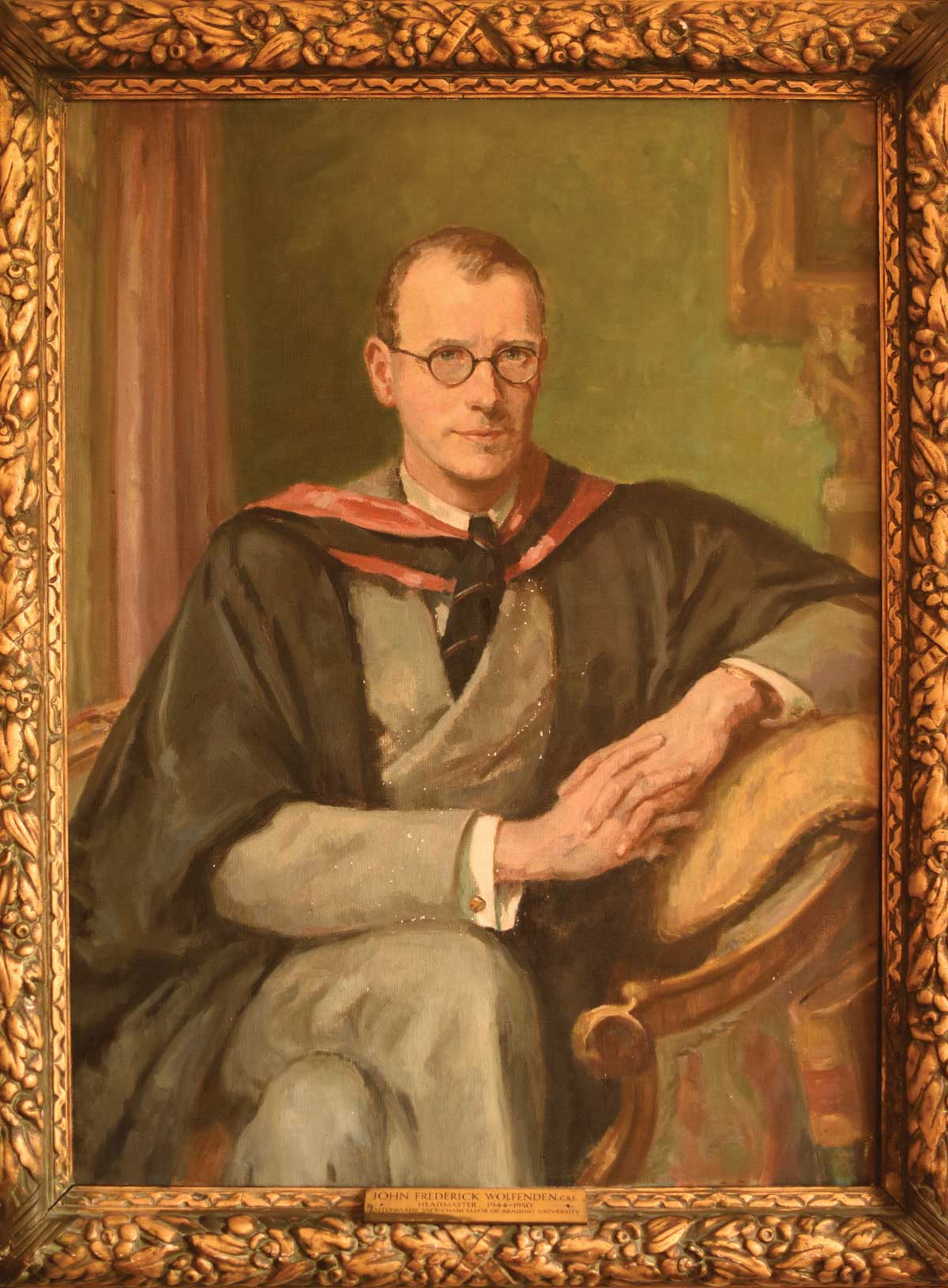
We have a room at School named after you. Lord John (aka ‘Jack’) Wolfenden.  Imaginatively, we call it the Wolfenden Room.  This honours you as a former Headmaster of Shrewsbury School (1944-1950). 

Jack Wolfenden’s portrait at Shrewsbury School

However, your name is more widely associated with the ground-breaking report published in 1957 that bears your name: The Wolfenden Report.  

After you were Headmaster of Shrewsbury, you went on to be Vice-Chancellor of Reading University, Director of the British Museum, a life peer in the House of Lords, and a very influential figure in public life. (So, there’s hope for me yet!)

Male homosexuality had been illegal in England since an act of parliament in 1533. Female homosexuality was never specified in law. It has never been illegal to be a lesbian; neither was is tolerated, accepted or spoken about until relatively recently. The law became more emphatic in 1885 with the Criminal Law Amendment Act, which made all homosexual acts illegal, even those carried out in private.

After WWII, arrests and prosecutions for homosexuals increased. For example Alan Turing, the cryptographer who helped to break the German Enigma code, was victimised for his homosexuality. Charged with ‘gross indecency’, he was forced to choose between prison or hormone treatment. He also lost his job. His death in June 1954 was treated as suicide.  All caused by the attitudes of his time.

Turing’s case, and those of other high profile individuals such as the actor John Gielgud, led the government to set up a Departmental Committee of 11 men and 4 women to consider both homosexual offences and prostitution.  Jack Wolfenden was appointed Chair of the Committee.

The committee first met on 15 September 1954 and over three years sat 62 times. Much of this time was taken up with interviewing witnesses. Interviewees included judges, religious leaders, policemen, social workers and probation officers.

Jack Wolfenden in Committee

During the time the committee sat, you discovered that your own son was homosexual.

Your influential report put forward the recommendation that ‘homosexual behaviour between consenting adults in private be no longer a criminal offence’.

Two members of the committee had resigned during the process and one remaining member of the committee openly disagreed with the recommendation. But, the recommendation was made. And it was a pivotal moment in the advancement of gay rights.

The report recommended decriminalising homosexuality. Although the report condemned homosexuality as ‘immoral and destructive’, it concluded that the law’s place was not to rule on private morality or immorality.  It also said that outlawing homosexuality was a civil liberties issue.

It took a long time for the report to convert into law.  There was plenty of opposition.

The Home Secretary who had commissioned the committee didn’t actually like the findings – he has hoped the committee would recommend tougher legislation against homosexual acts between men. 

This gives us some sense of the heavily dominant assumptions of the time.

Instead, the report proposed that there ‘must remain a realm of private morality and immorality which is, in brief and crude terms, not the law’s business’. The report’s findings were debated in Parliament but a motion in 1960 to implement the report’s findings was lost and efforts to implement the report’s findings were stalled.

The Sexual Offences Act passed in Parliament in 1967, 10 years after the publication of the report. Based on the Sexual Offences Bill, the Act relied heavily on the Wolfenden report and decriminalised homosexual acts between two men who were both consenting and both over the age of 21. 

The Act, when it did arrive, applied only to England and Wales. (Scotland decriminalised homosexuality in 1980 and Northern Ireland in 1982.)

It should be said that there is a big difference between decriminalisation and legalisation.  Peter Tatchell, the well-known contemporary gay rights activist, commented on the 60th anniversary of the Wolfenden Report in 2017:

“The report did not urge the repeal of anti-gay laws, merely a policy of non-prosecution in certain circumstances. The existing, often centuries-old laws were to remain on the statute book under the heading “unnatural offences”.

In other words, by only moving a little bit in the direction of acceptance, the 1957 report was just a bit less prejudiced – it was hardly emancipatory.  It is one thing to decriminalize; quite another to actively accept.

How does history judge you, John ‘Jack’ Wolfenden?  Well, it is only fair to judge the Report in the context of the attitudes of 1950’s Britain.  In this context, it was pivotal.

The Wolfenden report began an important process that ultimately led to the decriminalisation of homosexuality in Britain. And beyond that, paved the way for further breakthroughs in equality legislation.  Much more recently, Parliament passed the Marriage (Same Sex Couples) Act in 2013 which introduced civil marriage for same-sex couples in England and Wales.

Judged by the standard views of your time, we can justifiably view you as an influential reformer – a champion of greater acceptance of diversity in matters of sexual orientation. You triggered a change moment – one that set off a slow and sometimes stuttering progression towards fair treatment for all sexual orientations – one that is ongoing today.

What else do I learn from you, my predecessor, dear Jack? At least these three things:

  • That deep change takes time – steps, increments, the occasional leap; some things can be done quickly, often the most important things take time.
  • That this is particularly true of cultural attitudes – shifting dominating moralities and enabling pluralism takes time; you don’t often get there in one glorious jump
  • That deep change requires leadership – it takes determination, persistence – it requires courage – one of our 6 Salopian virtues.

I think that all at associated with Shrewsbury should feel quietly proud of the link between us and you, Baron John ‘Jack’ Wolfenden. You provide an inspirational example of the willingness to challenge received ideas; to re-shape thinking (your own and others’); and to push doggedly yet respectfully for a more tolerant, fairer society.

@leowinkley