Dear Bean

The humble bean is, intrinsically, all about potential.  For anyone working in education, icons of potential are irresistible fodder.  If all is right within the bean, we need not worry: it will grow magnificently, in the right conditions. 

The Humble but Glorious Bean

Outwardly, a bean is a very simple thing from which many good things come. Coffee; chocolate; baked beans (wrongly named but still delicious).  Beans are great wholesome foods full of plant-based protein and fibre.  Admittedly, they can bring some gusty after-effects, but nothing is perfect.

The bean has, for centuries and across many civilisations, been the preferred medium for learning to count.  Beans are mathematical icons. The abacus would have been strung with beans.  Although accountants with a tendency to pedantry are sometimes referred to pejoratively as bean counters, the humble bean is a positive symbol of accuracy and diligent learning.
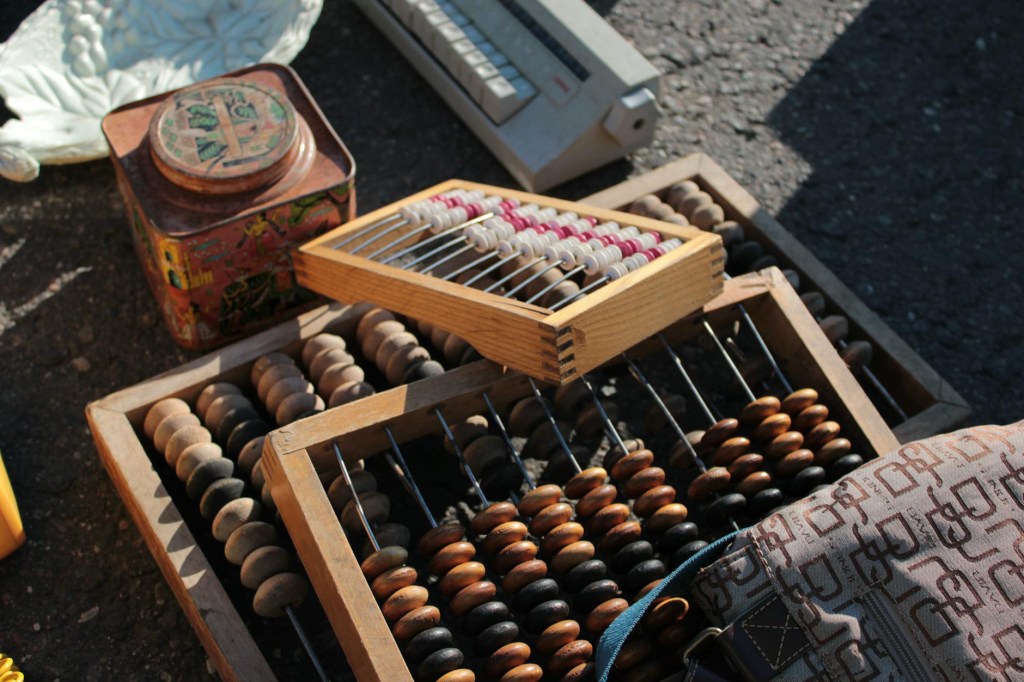
Bean Counters

In ancient Greece, beans were instruments of democracy. The practice of using beans for voting dates back to the city-states, where citizens gathered to make decisions on public matters. Voting was often conducted in a way that preserved secrecy and fairness, and beans provided a simple, practical solution.  Typically, two types of beans were used: white beans for approval and black beans to reject. Citizens would cast their vote by placing a bean into a jar or urn.
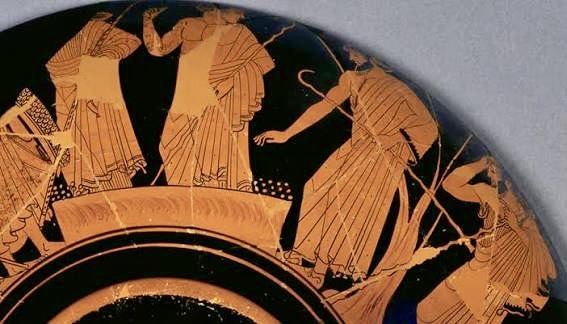
Casting Votes with Beans in Ancient Greece

The symbolism was powerful: a single bean could determine a person’s fate or influence the direction of a city-state. This system emphasized equality—every citizen’s bean counted the same, regardless of wealth or status. It was an early example of participatory governance, showing how simple objects could uphold democratic principles and civic participation.  So, the bean is a symbol of democracy – respect for individual opinions – and the right to privacy. The phrase ‘to spill the beans’ comes from this ancient democratic context.


The English fairy tale, ‘Jack and the Beanstalk’, is a standard in the festive Panto season in the UK.  Jack, a poor country boy, trades the family cow for a handful of magic beans, much to the dismay of his widowed mother.  However, the beans grow into a massive beanstalk reaching up into the clouds. Jack climbs the beanstalk and finds a road that leads to a big house, with a tall woman standing outside. He asks for breakfast and she gives him some, but warns that he might become breakfast himself if he is not careful, as her husband is an ogre with a savage appetite.   While Jack is eating, the ogre comes home.  The woman tells Jack to hide in the oven.
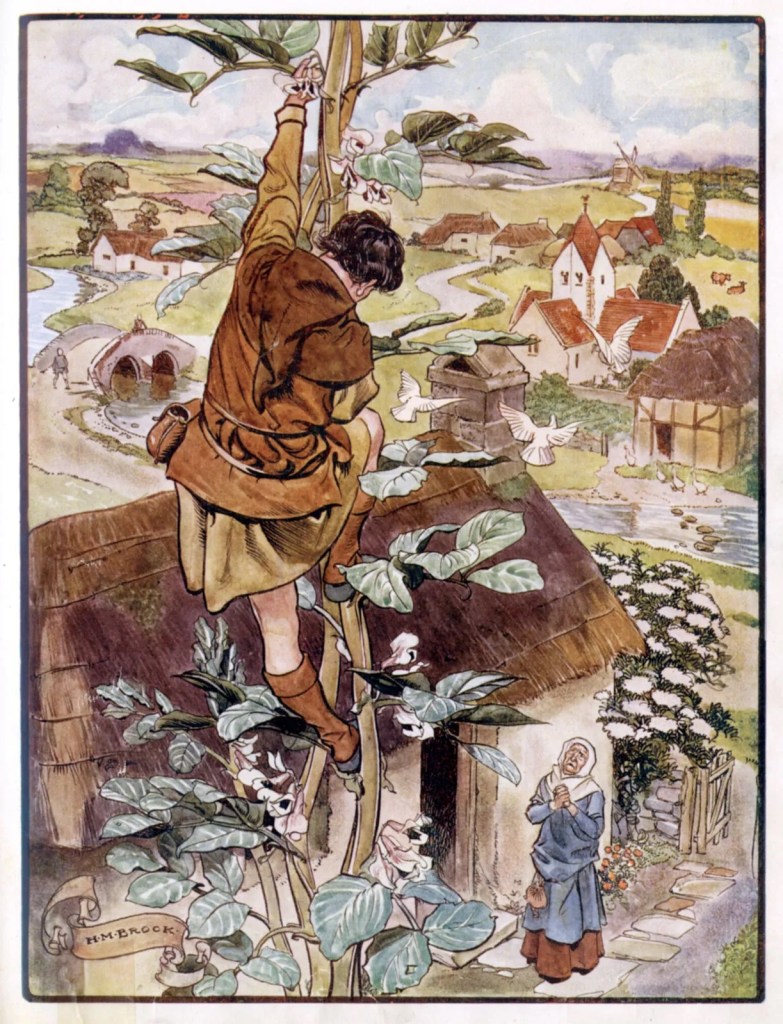
Jack Climbs the Beanstalk

Sensing the boy’s presence, the ogre cries his famous “fee-fi-fo-fum”.  However, the ogre’s wife, who has rapidly formed a liking for Jack, distracts her giant husband with a lavish breakfast of three broiled calves.  Afterwards the ogre takes out some bags of gold. Counting the gold, he falls asleep. Jack creeps out of his hiding place, takes one of the bags, and climbs down the beanstalk. He gives the gold to his mother, who is very happy. They live well for some time, until it is almost used up.

Jack decides to try his luck once more and climbs up the beanstalk. Again he meets the woman at the doorstep and asks her for breakfast. While he is eating, the ogre returns and Jack quickly hides in the oven. Again the ogre suspects that somebody is there, but again his wife deceives him, allowing Jack to hide.  After breakfast, the ogre asks his wife for “the hen that lays the golden eggs”. He says “Lay!” and the hen lays an egg of pure gold. The ogre falls asleep, and Jack takes the hen and climbs down the beanstalk.

Though Jack and his mother now have an inexhaustible source of golden eggs, Jack is not content. He climbs the beanstalk for the third time. He avoids the ogre’s wife, slipping into the house unseen and hiding in the wash-house boiler.  When the ogre comes home, he once more cries out “Fee-fi-fo-fum”, suspecting someone is there. His wife, rediscovering her marital loyalty, suggests that the little rogue that stole both his gold and lucrative hen may be hiding in the oven. But when they find the oven empty, the ogre eats his breakfast, then asks his wife to bring him his golden harp which sings beautifully when he orders it to “Sing!”

Once the easily-fatigued ogre has again fallen into a post-prandial slumber, Jack takes the harp and starts to leave, but the harp is a talking harp, loyal to the ogre, and calls out “Master! Master!” The ogre wakes up and sees Jack running away and pursues him. Jack nimbly climbs down the beanstalk, then asks his mother to bring an axe. He chops down the beanstalk and the ogre falls to his death. Jack and his mother are now very rich. They live happily ever after, which includes Jack’s inevitable fairy tale ending: marrying a princess. 


Magic Beans?

The positive spin on this story is that Jack’s adventure is all about the rewards for curiosity, courage and ambition. Jack dares to take a risk, trading the cow for mysterious and allegedly magic beans, and that bold choice leads to extraordinary opportunities. His climb up the beanstalk symbolizes striving for something greater, reaching beyond the ordinary. Jack’s resourcefulness and bravery in facing the giant suggest that challenges can be overcome with grit and determination. That small beginnings (like a bean) can lead to big outcomes.

However, the story is problematic.  Should we really admire Jack’s daring gamble in swapping a cow for some magic beans?  Should we actually celebrate his craft in stealing from the ogre in the land above the magical beanstalk?  Or should we view him as reckless and greedy?  Is the ogre, in fact, just misunderstood? 

The tale rather glosses over the morality of Jack’s actions. Jack steals from the giant: gold coins, a hen that lays golden eggs, and a magical harp. While the giant is portrayed as fearsome, we don’t get his side of the story – what it’s like to be an ogre whose space is invaded and possessions taken; he’s an ogre, a giant who, we are expected to say, deserves to be outwitted because he is different and threatening – even when you break into his house and sweet-talk his wife.   This tale suggests that cleverness and daring justify dishonesty, which is a problematic lesson.   

We might also question the loyalties of the ogre’s wife which sway rather easily to favour the young lad from the land below.  Or, we might view her as a victim too – of unhealthy masculinity of different types.  Or what about the post-colonial lens?  Jack, the imperial conqueror plundering treasures from foreign lands; the ogre the ignorant savage.


Should we, in fact, admire Jack?  Would it not be more admirable if Jack’s success had come through integrity, not exploitation and deception.  We might also worry that the story romanticizes risk without considering consequences.  Jack acts impulsively, and things could have ended very differently.

Should we fear and vilify the ogre?  Ever since the appearance of Shrek, ogre PR has been on the up.  However, this tale suggests that anything non-human and strange is not to be trusted.  Even if it’s minding its own business when you come bundling into its domain.

Now, you might say, it’s just a fairy story – a Christmas panto – and I’m being a boring killjoy labouring over the meaning of the tale.  But… the stories we tell shape the way view the world.  The accounts we accept (fictional or real), without critical reflection become our world; the heroes we promote and the villains we push away.  

Later versions of this fairy tale add some previous villainy to the giant’s rap sheet – eating oxen and little children – to make us feel more comfortable with Jack’s actions.  Although Jack is essentially a vigilante on the make, it seems much more acceptable that he robs and kills an ogre who has himself been wicked.  But, in the original, he is really targeted for being big, different, well-off and from another land.  Not the best justification for stealing his livelihood and ultimately knocking him off.


Jack’s tale might urge us to dream big and take a few risks.  No bad message as we start a new year, I suppose.  Reflecting with a more critical eye, it may also suggest that we temper our ambitions, and pursue them with a more measured and collaborative spirit, with honesty and responsibility.  Good things come through effort as much as through daring. 

Surely, it is better to accomplish our aims through collaboration and hard work, rather than shortcuts and deceit. In climbing our various ‘beanstalks’, we should pursue our goals boldly, but with fairness, kindness and respect for others.  

In other words, just as ‘Beanz Meanz Heinz’, being fully human means being fully humane beans.


Notes

This letter was written on 6 January (The Feast of Epiphany, a time of gifts).  It was a kind of epiphany to learn that there’s a day set aside especially for celebrating the bean in all its many, simple glories.  6 January is also National Bean Day.  

The iconic advertising slogan ‘Beanz Meanz Heinz’ was created in 1967 by copywriter Maurice Drake.  There are more than 57 Heinz varieties, but founder Henry J Heinz, who formed the company in 1896, thought the number 57 had a good feel to it – and it combined his and his wife’s ‘lucky numbers’.
Dear Pedestrian

Featured

Solvitur ambulando: ‘It is solved by walking.’

As a walker, you know this well.

This pithy saying – all the more pithy in Latin – is attributed to St Augustine.  It captures the sense that walking is more than just a physical activity.  Rather, it suggests that walking can be an act of mindfulness; a means of spiritual refreshment; a way of untangling the knots of the mind.  For many, walking and thinking are the closest of travelling companions.

I went through a phase of reading book after book about walking. It was in the aftermath of my father’s death in 2014.  I think, looking back, it was a way of reflecting on his life and its ending.  Big, long walks in the Yorkshire countryside were a way of processing.  I felt drawn to the paths of the East Yorkshire coast; it felt good to be small, yet strangely at home, in the rugged openness of the Moors; the gentle dales and valleys invited me to explore.  Following ancient ways – paths that had been covered by countless pairs of feet – connected me to the unknown folk who have lived and moved across the same land.   

When I wasn’t walking, I was thinking about walking.  I was reading about walking.  I read books by Robert Macfarlane, Roger Deakin, Henry David Thoreau, Frederic Gros, Rebecca Solnit, Geoff Nicholson, Nan Shephard, Patrick Leigh Fermor.  There are shelves of books on walking, natural history, landscape and language, psychogeography – all kept in our little cottage in the North York Moors.

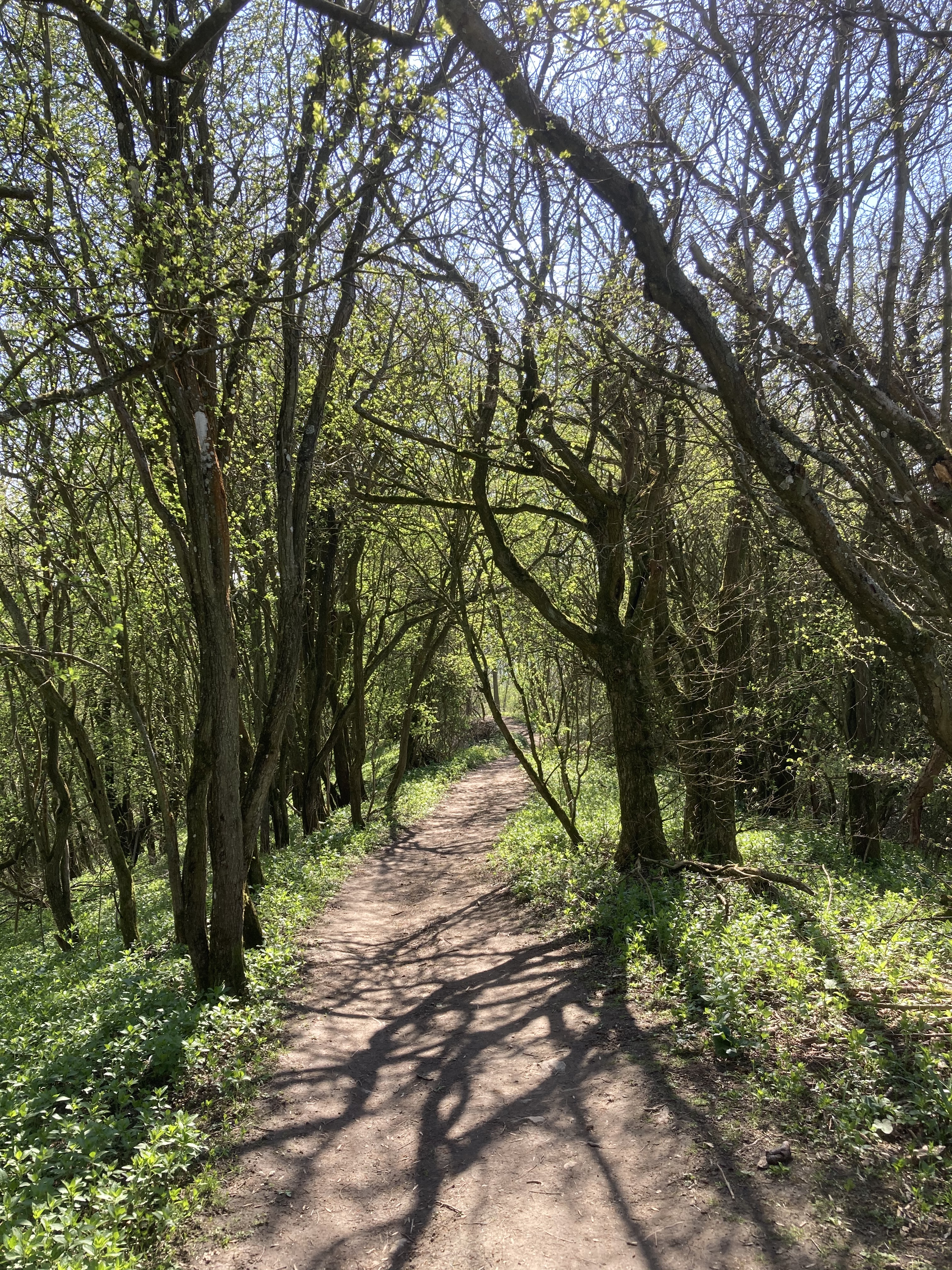
Holloway

My inner teenager would be both baffled and appalled at this strange obsession with the act of walking.  How on earth can walking be interesting?  The Pavlovian response of most teenagers at the prospect of a long country walk is a derisory scoff or a spontaneous list of other more urgent priorities.  For some, walking looks like a waste of time and energy.  Especially the circular walk beloved of ramblers – why on earth would we walk in a big circle that ends up where we started? 

The word pedestrian (as an adjective) has a telling meaning: ‘prosaic, commonplace, dull’. Doesn’t that tell us something about the status of a walk?

Most prosaically, of course, walking is an act of locomotion; of self-propulsion; it is the simplest practice of getting from A to B.  It is a form of exercise and means of staying physically healthy.  More expansively, walking is a way to discover and explore the external world.  At a deeper level, walking can make us happier.     

Like many of the routine capacities that the fit and healthy take for granted, the able-bodied take the daily process of walking unthinkingly in our stride.  For those who find walking easy, we don’t often register that this unconscious process is supremely complex.  The ability to walk was hard-earned, and hard-learned, over months of early childhood development.  We learn to walk and are free.  Viewed this way, walking is a privilege.  More empoweringly conceived, it is an act of self-determination.  And a route to inner discovery.

You can see why slow self-locomotion seems ordinary next to the rapid movement of car, plane and rocket.  As the industrial revolution brought speed, along with so much else, shanks’ pony became equated with backwardness and poverty.

And yet… slow can be good.

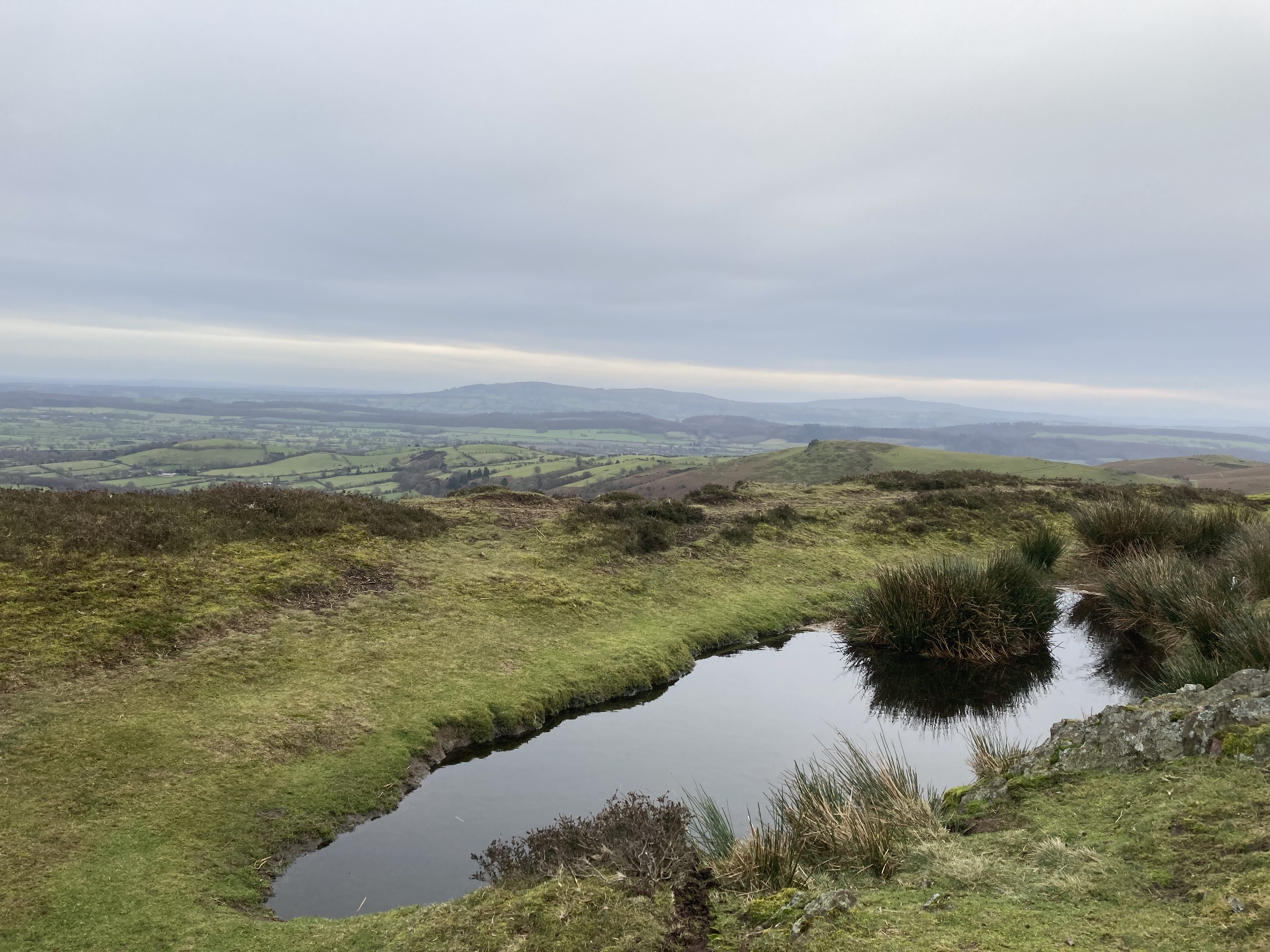
View from Caer Caradoc

During lockdown, the daily walk has become disproportionately important.  For most, the local wander was the default leisure activity.  Ask someone what they did at the weekend during lockdown and they will almost certainly reference a walk.  Being pedestrian has been crucial to our wellbeing.

In the 18th and 19th centuries, pedestrianism was a spectator sport; an heroic activity that drew fans and inspired a degree of celebrity.  Walking was a means to epic feats and the focus of wild wagers.  For example, the legendary pedestrian Captain Robert Barclay Allardice’s most impressive achievement was to walk 1 mile every hour for 1000 consecutive hours between 1st and 12th July 1809.  People travelled to see him walk.  Many other men and women became competitive endurance or speed walkers.  Over time, this craze for pedestrianism gradually passed and became obsolete.  However, history shows that being a pedestrian was not always pedestrian.  

Returning to the current day, walking is a means of exercise and relaxation for many.  You come back from a decent walk feeling physically tired and mentally refreshed.  The quick wander with the dog; the late afternoon perambulation – these all help to dislodge the lumps in the mind’s path. 

I think it is one of the many uniquely special things about Shrewsbury School life that we – by which I mean pupils and staff alike – all do a lot of walking in our daily routines.  Our 100 acre site has walking designed into it. 

Shrewsbury School Site – walking to work

We have to walk from house to lessons; from one building to another; to and from meals.  We walk through a shared  place of calm, natural beauty. I think this is a very healthy thing for all of us.

Walking, woven into our daily routines, is good for the mind and the body.  And it can also help with problem-solving.

Whatever ‘it’ is – it may well be solved, or at least eased, by walking.

Keep walking, dear Pedestrian. 

Dear Detectorist

Featured

Can I set the scene? It’s a beautiful English summer’s day.  We’re on a sandy beach in North Yorkshire.  It’s one of those rare, ultra-calm, windless days when sound travels with exceptional clarity and everything feels close, and yet distant, at the same time.  

There are several families on the beach, climbing on the rocks, building sandcastles, skimming pebbles into the sea.  The air is perforated with the shrill cries of children on the beach and those of the circling seabirds overhead. 

A group of canoeists paddles into the bay and beach their canoes.  About 10 of them sit down on the beach and produce a lavish and unlikely picnic, cracking open bottles of beer and reclining in wet-suited splendour, looking, from a distance, half-human, half-seal.

On the cliffs we can see nesting gulls.  There are bird-watchers toting binoculars and draped in bits of kit. There to spot anything with feathers.  Crowds of twitchers along the clifftop, angling their necks and pointing their bins to capture the plummet of the gannet; the serene arc of the curlew; the rock-hopping of the oyster-catcher; the busy aeronautics of distant puffins. 

The tide is at its lowest, so you can clamber all the way through some of the caves and reach the open see the other side.  The rock pools are populated with anemones and seaweed.  There are barnacles aplenty on the craggy rocks.  With a firm stab of a booted foot, you can dislodge a stubborn little arthropod, inspect its inner workings, emit a noise of fascinated disgust, and carefully reinstate them on the rock.  You can look for crabs in the rock pools. 

Then, a new couple comes down the steep steps carrying two metal contraptions.  Those of us already established on the beach are giving them the once over. Gently sizing up the new arrivals, as they rattle their way onto the strand. We reckon that they are mother – probably in her 60s – and grown-up son – around about 40.  We surmise that he’s single, quite possibly still living in the maternal home.  Something about his clothing suggests that: the saggy luminous orange kagool zipped up despite the clement weather.  Beige trousers that are just a bit too short in the leg.  And, the footwear: a frightful public union of sandals and socks, so often the preserve of the unattached.

Saying very little to one another, each puts on a pair of chunky red head-phones.  They plug the lead into their devices.  And off they go.  Pacing – slowly, methodically – up the beach.   Sweeping their instruments before them.  Immediately engaged in their work.  Immersed.  Listening intently for a ping – a ping that would signal the confirmation of metal. Occasionally they stop; put the metal detector to one side; and dig with a small trowel in the sand.  And turn up something, nothing.  Something and nothing.

They do this for an hour and a half.  Gradually, the pair becomes the object of most people’s attention.  As we all keep a casual eye on them, questions gently mount in the mind, like sand passing through an hourglass.

Eventually, idle curiosity grows into something more urgent and we have to break the silence.  Someone goes over to address the pair.  “Have you found anything yet?”.  The man, to whom the question was directed, jumps in surprise.  “Sorry!”, we say.  “Didn’t mean to shock you….  Have you found anything?”.  Probably an annoying question to poke into this unwelcome break in his focus.  “Not yet”.   It’s clear that conversation is not high on his agenda for the day.  “What’s the best thing you’ve found?”, we persist. “Found a Roman coin once. Gave that in.  Mostly it’s ring pulls ‘n shot gun cartridges”.

So, let’s get this straight. You spend all that time looking and you only get to keep the things that aren’t worth anything. “Yes, that’s about it”.

All pass-times can seem a bit clubby, a bit geeky to the uninitiated. But it’s fair to say that metal detecting would probably come in quite low on a league table of activities that command instant respect. Adrenalin sports would top that table: base-jumping; parkour; free-climbing. These are high impact activities where adventure, movement and risk are the chief gods.

Your deities are different.  The gods of metal detecting are method, patience and luck.  It is a ritual of hope.

An archaeologist will likely bristle at the sight of you.  Others might disparage you as funny, slightly deluded individuals grubbing about in largely fruitless isolation.  I’ve never done any metal detecting but there’s something rather wonderful about the sight of you.  The undiluted focus, the obsessive fascination, the hermetic zeal of the activity.  Something meditative about the gentle hovering of the detector disc above the ground, its faithful attention fixed on the floor, as you guide its slow, sweeping motion. 

You and your metal detector are bound in a mutual and private search.  You seem so focused on the detecting work, so insulated from other events, that I could easily imagine you walking with steady confidence off a cliff – still listening for the jubilant beep.

Why do you do it?  Is it because you’re looking to find that special find?  Or because you are part of a citizen scientist movement, democratising knowledge and encouraging a love of heritage. Or, do you do it because the process of looking is, in itself, a pleasant, addictive, even life-enhancing state? Metal detecting, like fishing, is about waiting. 

So, I’m putting aside any sniggering assumption that people who use metal detectors should be pitied or even derided for their dodgy clothing and apparent lack of social skills. I’m going to park the idea that your type are acquisitive Golums, addicted to antique shiny things; or rural bounty hunters methodically stripping the land of its precious little secrets. Maybe you detectorists are ok. Oddly cool. Maybe even role models.

As an activity, metal detecting requires patience and method.  It encourages the constant readiness for discovery; the acceptance of simple labour in the pursuit of some ecstatic moment, a chance unearthing of something really interesting, really valuable.  Like all the best hobbies, metal detecting stands on a central foundation of futility.  And the infinite resurgence of hope over experience.

If I’m feeling poetic, I could see your metal detectors as instruments of hope. Ok, they may not be style magnets but, viewed in this way, they are images of the human being’s desire and determination, to search out truth and beauty, and to continue to hope that truth and beauty do indeed lie out there.  Truth and beauty are often to be found buried, obscured by the accumulated silt of other, less remarkable things.

All the great thinkers and spiritual leaders have emphasised the need for hope.  We know that human beings are capable of acts of ugliness, cowardice and falsehood.  These thinkers hold us firm to the belief that, as individuals and as communities, human beings are capable of great beauty, courage and truth.  And that these great universals can be unearthed in all kinds of places; in all kinds of interactions with others. 

Presumably, detectorists are afflicted by finite disappointment on a routine basis.  It’s part of the process.  But you seem to be powered by infinite hope. Maybe you detectorists aren’t that odd after all. 

Maybe I’ll follow you up the beach and see what I might find. Or not find.

Leo